If you are exploring how to become a U.S. citizen, one of the key forms you will encounter is the Form N-400, Application for Naturalization. This is the official document issued by the U.S. Citizenship and Immigration Services (USCIS) that you submit when you decide you are ready to take the final step toward citizenship. Because this step is so meaningful, it is natural to feel anxious, uncertain, or overwhelmed. You might wonder whether you qualify, how long it takes, or whether you will make a mistake. The more you understand the N-400 and the good-faith steps you can take, the more confident you can feel.
When you file the N-400, you are declaring that you believe you meet the eligibility requirements for naturalization (becoming a U.S. citizen). You are asking USCIS to examine your application, review your background, test your knowledge of English and civics, and ultimately, if approved, schedule you for an oath ceremony to become a citizen. It’s a major milestone. While the process can feel long, it is also tangible and achievable. Many people before you have done it, and you can too.
Completing the N-400 is not just a formality. It is the formal start of the citizenship process. Once USCIS receives and accepts your application, you will receive a receipt notice, attend a biometrics appointment, interview, and if approved, participate in an oath ceremony. By understanding what the form is and what it triggers, you can reduce some of the anxiety that comes from uncertainty. Your preparation now helps set the stage for the months ahead.
As you read through this article, you will get a full picture of who can file the N-400, how to fill it out, what requirements apply, what fees you should expect, how long the process usually takes, and common mistakes to avoid. The aim is to guide you step by step, in an empathetic way, so you feel supported and informed as you move toward citizenship.
Who Is Eligible to File Form N-400 for U.S. Citizenship?
Before you fill out the N-400, it’s essential to check whether you meet the eligibility requirements, because filing too early or without the requisite qualifications could cause delays or complications. USCIS defines eligibility in its official information. The eligibility rules are structured around your age, permanent resident status, residence and physical presence in the U.S., good moral character, ability to speak/read/write English (with some exceptions), and basic knowledge of U.S. civics.
First, you must be at least 18 years old at the time you file the N-400. Filings by minors are not permitted because citizenship is an adult status. Next, you must be a lawful permanent resident (LPR), in other words, you must hold a “green card”, and meet the continuous residence and physical presence requirements. The most common route is the five-year rule: you must have been an LPR for at least five years. If you are married to a U.S. citizen, you may be eligible after three years of being an LPR, provided you meet certain marriage-related conditions. These rules are explained on the USCIS site.
Second, you must show that you’ve continuously lived in the U.S. during the required period and that you’ve been present physically for at least half of that period. “Continuous residence” means you have made the U.S. your permanent home and not taken long trips abroad that disrupt your ties. “Physical presence” means you’ve actually been in the U.S. for the specified months. For example, under the five-year rule, you must have been physically present in the U.S. for at least 30 months (two and a half years) out of the five years.
Third, you must demonstrate “good moral character.” This is a legal term meaning that you have obeyed U.S. laws, paid taxes, not committed certain crimes, and generally behaved in a way consistent with the responsibilities of citizenship. USCIS evaluates this usually for the five-year (or three-year) statutory period, though in serious cases they may look further back. Additionally, you must show you are able to read, write, and speak basic English (unless you qualify for an exemption), and you must pass a civics test covering U.S. history and government (again, unless you qualify to be exempt). These requirements help ensure that new citizens are integrated and prepared for civic participation.
Finally, you must show that you plan to reside in the U.S. and abide by the Constitution. If you meet all of these eligibility requirements, then you may file Form N-400 and begin the journey toward citizenship. If you do not yet qualify, for instance, if you’ve been an LPR less than three or five years, you can prepare while you wait, ensuring your residence records are in order, you’ve maintained your status, and you’re ready for the next step when the time comes.
How To Fill Out The N-400 Form
Filling out Form N-400 can seem daunting at first, the form is several pages long, and it asks detailed questions about your background, residence, travel, employment, and more. But with a calm, step-by-step approach, you can complete it accurately and confidently. The key is preparation, attention to detail, and reviewing your responses. Let’s walk through how to fill out the form, and then we’ll discuss the specific requirements, mailing address, fee, and fee waiver options.
First, you should obtain the most current version of the form from USCIS. You can file online (if you are eligible) or by paper. When you open the form, start by reading the instructions carefully, especially because filing incorrectly can lead to delays or rejection. At the top you will provide your personal details: full legal name, current address, date of birth, Alien Registration Number (if applicable), and so on. You’ll also report all other names you have used (maiden, aliases, changes) and provide your Social Security number (if any). Accuracy here matters, if your name on documents doesn’t match, you might face unnecessary questioning.
Next, the form will ask about your residence and employment history during the statutory period (three or five years depending on eligibility). You’ll list addresses where you lived, travel outside the U.S., and any times you were absent. Then you’ll answer questions about your marriage and family status, children, previous immigration filings, and whether you have any criminal history or other issues. Because these are sensitive questions, it helps to gather documentation ahead of time (taxes, rental/mortgage records, travel stamps, previous USCIS notices) to support your responses.
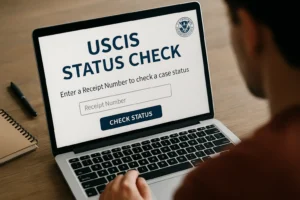
Finally, you’ll sign the form and pay the filing fee (or request a fee waiver or reduction if eligible). After you submit, you’ll receive a receipt notice (Form I-797C). That notice contains your receipt number, which you should keep and use to track your case online at the USCIS Case Status page. Once you submit your application, you’ll await a biometrics appointment, interview, and other steps. The key is that you submit a clean, accurate, and complete form at the outset, that goes a long way toward avoiding delays.
N-400 Form Requirements
When you get ready to fill out Form N-400, you need to be aware of several critical requirements, both eligibility requirements, which we covered earlier, and procedural/documentation requirements. Meeting these will help ensure your application is accepted and moves smoothly through the process.
Important requirements you should confirm include:
• You are at least 18 years old at the time of filing.
• You are a lawful permanent resident (LPR) and meet the three- or five-year residency rule.
• You have maintained continuous residence in the U.S. and meet the physical presence requirement.
• You are prepared to show good moral character.
• You can read, write, and speak basic English (unless exempt).
• You can pass the civics test on U.S. history and government.
• You plan to remain a U.S. resident and take the Oath of Allegiance.
In addition to those eligibility criteria, your N-400 application must include certain supporting documents. For example, you may need to submit:
- A copy of your permanent resident (green) card.
- Two passport-style photos (in some cases).
- Evidence of name change (if your legal name changed).
- Documents showing selective service registration (if applicable).
- Proof of any qualifying condition for English or civics test exemption (if applicable).
You’ll also list all trips abroad during the statutory period and provide reasons if any absence was long. Being organized helps you respond to these sections accurately. The official USCIS N-400 page says you should “review all the questions carefully and answer truthfully and completely.”
N-400 Form Mailing Address
If you are filing the N-400 by paper instead of online, it is crucial to send your form, supporting documents, and fee to the correct USCIS lockbox or service center. USCIS publishes direct-filing addresses, which vary depending on your state of residence and whether you are paying a fee or requesting a waiver.
Using the wrong address is one of the most common reasons applications get delayed or returned. Be sure to check for your exact county or state, online filing vs. paper filing, and whether you are using a courier or U.S. postal mail. After you mail or submit online, your N-400, you should receive a receipt notice (Form I-797C) within a few weeks, which includes a 13-digit receipt number you can use to check status online.
Form N-400 Fee
Filing for U.S. citizenship involves a fee, which is paid at the time you submit Form N-400, unless you apply for a waiver. As of this writing (2025), the standard fee for Form N-400 is $760 when filing by paper and $710 when filing online. The fee covers the cost of processing your application and biometric collection (if required). If you are eligible for a reduced fee, the cost may be $380. It’s important to check the USCIS Fee Schedule regularly, as fees may change in future years.
When you pay the fee, note that a filing error or incorrect payment may lead to rejection. If your fee is underpaid, USCIS may reject your application and you would have to refile, restarting the process and increasing your waiting time.
N-400 Form Fee Waiver
If you are experiencing financial hardship or meet certain income criteria, you may request a fee waiver or reduced fee instead of paying the full amount. USCIS allows for a full fee waiver (zero cost) or a reduced fee for qualified applicants. To qualify for a fee waiver, you must demonstrate one of the three criteria:
- Receipt of a means-tested benefit (such as Medicaid, SNAP, SSI).
- Household income at or below 150% of the Federal Poverty Guidelines (FPG).
- Incurring “financial hardship” such that you cannot pay the fee without suffering hardship.
When seeking a reduced fee instead of full waiver, your household income needs to be between 150% and 400% of the FPG. These rules changed in 2024, so always check the latest instructions, as noted in an advisory from the Immigrant Legal Resource Center.
If you apply for a fee waiver, you must file on paper; USCIS does not currently accept online filings with a waiver request. Your N-400 will include a part where you indicate your fee status, and if you apply for a waiver you must attach Form I-912 (Request for Fee Waiver) or follow the instructions as provided by USCIS.
N-400 Form Timeline
Understanding how long the naturalization process takes helps you prepare emotionally and practically. While no two cases are identical, you can expect certain steps and timeframes once you file Form N-400. These timelines vary by field office and workload, but knowing the typical range helps you plan where you stand.
Here’s a rough breakdown of the steps and how long each might take:
- After you file the N-400 and submit payment, you usually receive a receipt notice (Form I-797C) within 2 to 4 weeks (though times can vary).
- Next you will be scheduled for a biometrics appointment (fingerprints, photo, signature). This typically happens 4 to 8 weeks after filing, but could be longer depending on your local USCIS office.
- Then comes the interview and civics/English tests. Many applicants receive the interview notice 3 to 7 months after filing, again depending on local processing. Some field offices take longer, some shorter.
- Finally, once you pass the interview, USCIS schedules your oath ceremony (the moment you officially become a citizen) within a few weeks to a few months after approval.
In many cases, applicants report their total timeline from filing N-400 to US citizenship is between 7 months and 15 months, depending on location and case complexity. For example, the USCIS tool may show 12 to 16 months for a particular field office for N-400 while showing 8 to 14 months in others. Because each office’s queue changes, you will want to check your specific processing time by selecting “Form N-400” and your local field office.
You should monitor your case status online using the receipt number on your I-797C. If your case significantly exceeded the estimated range for your office, you may submit an inquiry.
While waiting, it helps to remain patient, keep all your contact information up to date with USCIS, maintain your permanent resident status, keep good moral character, and not plan major travel or changes until you’re nearing final stages. Your preparation now helps your application proceed more smoothly.
Common N-400 Mistakes That Cause Delays or Denials
Filing Form N-400 can feel intimidating and one of the biggest sources of stress is making a mistake that causes a delay or worse, a denial. The good news is that many of the common problems are avoidable with careful preparation. Here are the most frequent mistakes and how you can avoid them.
- Incomplete or Incorrect Form
One of the most common issues is that applicants leave questions blank, provide inconsistent information, or attach incorrect photos or signatures. USCIS may send a Request for Evidence (RFE) or reject your application entirely if key items are missing. An RFE can add weeks or months to your processing time. To avoid this: read all instructions, double-check each entry, include all required attachments, and ensure dates and names match your documents.
- Insufficient Documentation of Eligibility
Some applicants misunderstand the three-year vs. five-year rule or fail to provide evidence of continuous residence or physical presence. Others neglect to provide evidence of name changes, failed to include proof of lawful permanent resident status, or omitted required information about trips abroad. These kinds of omissions often cause delays. Review the eligibility criteria carefully and finish your application only when you are sure your records are accurate.
- Failure to Reveal Past Issues or Criminal History
“Good moral character” is a key requirement. Many applicants worry that disclosing past arrests, unpaid taxes, or other issues will lead to denial. The greater risk is not disclosing them. If you fail to disclose required information, USCIS may deny your application or issue an RFE. It is always better to be truthful and provide explanations. If you believe you have issues that may be problematic, consult an immigration professional before filing.
- Travel or Residence Issues
If you took long trips abroad (especially six months or longer) or moved frequently without updating your address, USCIS may question whether you maintained continuous residence. If you changed jobs many times or have gaps in your employment history without explanation, those issues can also raise questions. Review your travel and residence history carefully and explain any long absences. Your support documentation helps avoid unnecessary delays.
- Filing Fee Mistakes or Filing Too Early
If you submit the wrong fee or submit online when you have requested a waiver (which requires paper filing), your application may be rejected. Also, some applicants attempt to file N-400 before they reach their eligibility date. You are allowed to submit up to 90 days before you reach the three- or five-year residency mark, but filing earlier than 90 days will result in a rejection.
Being aware of these common issues, taking your time, and asking for help if you feel unsure can make a big difference in reducing stress, avoiding time-consuming mistakes, and increasing the chance of a smooth path to citizenship.
Where To Send N-400 Application Form
Having filed the N-400 online, paper filing is less common but still used in many cases, such as when you are requesting a fee waiver or if USCIS requires paper submission. In those situations, you must send your application to the correct USCIS address. Sending it to the wrong address can result in delays or rejection.
You can check in the USCIS page for the address, you will search your state of residence, whether you are paying the fee, and whether you are seeking a waiver. It will show the correct lockbox facility (or service center) to receive your package. Commonly used addresses include USCIS CIS Lockbox in Florida, Chicago, Phoenix, or Dallas, depending on geography and whether you are using USPS or a courier service such as FedEx or UPS.
Important details to remember:
- Use the correct courier address if sending via express service rather than standard U.S. mail.
- Make two copies of everything you send, one to keep for your records and one to mail.
- Use a secure mailing method with tracking and retain the proof of delivery.
- Ensure you include your receipt number (if you’ve already filed) and address updates if you move after submission.
If you filed online, the address page is still helpful because it shows how USCIS wants you to submit supplementary documents such as a fee waiver or biometrics location change. Double-checking at the address stage is key to avoiding surprise delays.
Conclusion
Filing Form N-400 and taking the step toward U.S. citizenship is a significant, rewarding, and worthy path, but it is natural to feel nervous as you navigate the requirements, fees, and timelines. With the information in this guide, you now know what the form is, who is eligible, how to fill it out, what fees apply, the typical timeline, common mistakes, and where to send your application. While you cannot control every variable (such as how busy your local USCIS field office may be), you can control your preparation, accuracy, and readiness.
Taking this journey seriously means planning ahead, reviewing your eligibility, gathering all necessary documentation, filing thoughtfully rather than quickly, and tracking your application once filed. If you encounter obstacles, delays or uncertainty, remember that it is entirely normal and many applicants experience similar challenges. What matters most is to stay informed and proactive.
Should you ever feel unsure about a section of your application, a complex background issue, or simply want someone to walk with you through the steps in a quieter, clearer way, know that YT Multiservices is here to provide gentle guidance, help organize your materials, and support you through the process. You don’t have to travel this path alone.
You are very close to a major milestone. With preparation, patience, and clear information, you can move forward toward citizenship with confidence and peace of mind.