If you are looking up the cost to become a U.S. citizen, you are usually trying to plan your next steps with less uncertainty, not just satisfy curiosity. The tricky part is that the “cost” is not only about one government payment, because the naturalization filing fee is just one piece of what people end up budgeting for, especially when you include document preparation, translations, travel, and time away from work or family obligations.
At the same time, the most responsible way to talk about citizenship costs is to avoid outdated numbers. USCIS fees can change, and even when the fees stay the same, the rules about how you file, what counts as a complete packet, and what evidence is expected can affect whether you file smoothly or deal with delays that feel expensive in daily life.
This article is general information based on official USCIS and U.S. Department of State resources and on practical document planning. YT Multiservices is a Florida notary public and an immigration forms preparation specialist, not a law firm, and they do not provide legal advice or legal representation. Their support is focused on helping you prepare forms and organize documentation so your filing is clear and submission ready.
Citizenship Application
For most people, the path to U.S. citizenship through naturalization starts with Form N-400, Application for Naturalization. USCIS explains that the N-400 can be filed online through a USCIS account or filed on paper by mail, and your choice of filing method matters because it affects how you submit your documents and how you receive case updates and notices.
Even when the topic is money, it helps to remember that USCIS is not only charging for “a form.” The filing fee is connected to the agency’s processing of your request, background checks, and the overall administration of your case, which is why the government fee is usually the biggest single official cost for the naturalization step itself.
A common surprise for applicants is that “online” is not always available for every situation. USCIS specifically states on the N-400 page that if you are requesting a reduced fee or a fee waiver, you cannot file Form N-400 online and must file a paper application instead, which means your cost planning and your filing method planning are tied together.
Another practical point is that your citizenship application is more than the form fields you type or write. USCIS expects you to submit the required evidence and supporting documents that fit your situation, and how you handle that evidence can affect whether you move forward smoothly or get a request for more information that adds stress and extra preparation work.
If you want the filing experience to feel less overwhelming, it often helps to treat the N-400 like a document project. Many people find relief when they have someone help them organize their paperwork, double check consistency, and make sure the packet is assembled in a way that matches USCIS filing expectations, especially when they are balancing work, family, and tight timelines.
Fees for U.S Citizenship
The government cost of naturalization is primarily the USCIS filing fee for Form N-400. USCIS recommends using its official fee resources to determine the exact filing fee required for your form and filing method, because the calculator and fee schedule are kept current.
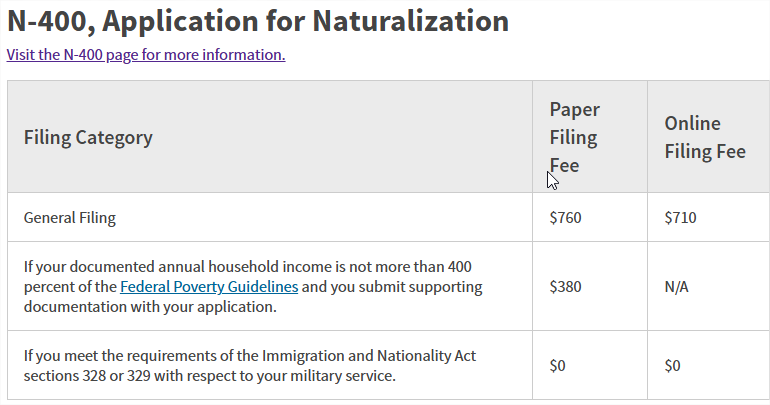
USCIS also maintains a central Filing Fees page that points applicants to the Fee Calculator and official guidance, which is the safest place to confirm the current amount right before you file. This matters because a fee mistake can lead to rejection and a forced refile, which can feel like losing time and momentum even if you eventually get it right.
When people ask about citizenship “fees,” they sometimes assume there are many separate charges. In practice, most applicants are planning around one main USCIS payment for the N-400 step, while the rest of the costs are usually personal preparation costs, like paying for document copies or translations if you need them.
USCIS indicates that filing method can matter for the amount you pay, and the agency’s own materials emphasize confirming the required fee based on whether you file online or by mail. Instead of locking yourself into a number too early, the best habit is to budget generally and then confirm the exact amount right before you submit.
One hidden cost that many families do not anticipate is the “cost of delays.” If your packet is incomplete or your evidence is hard to interpret, USCIS may issue a request for evidence, and responding often means printing more documents, paying for additional translations, or taking additional time away from work to gather what is needed.
If you are trying to minimize those avoidable costs, the goal is to file cleanly the first time. YT Multiservices helps applicants prepare immigration forms and organize supporting documentation so the submission is orderly, consistent, and easier for USCIS to review, which can reduce the chance of preventable administrative issues.
U.S. Citizenship Application Fee Reduction
USCIS offers a reduced fee option for certain applicants who do not qualify for a full fee waiver but still need the filing fee to be more manageable. USCIS ties reduced fee eligibility to documented household income relative to the federal poverty guidelines and explains the process through its official reduced fee guidance.
USCIS uses Form I-942, Request for Reduced Fee, for specific forms including the N-400, and the official I-942 page explains that it is designed to request a reduced filing fee when you meet the eligibility requirements tied to household income.
Because reduced fee requests depend on documentation, most of the work is not “filling out the form,” but proving the financial picture USCIS is asking you to show. USCIS provides the poverty guideline reference page as a tool for understanding how household size and income guidelines are used in reduced fee and fee waiver contexts.
A key detail that matters in everyday life is the filing method. USCIS states that if you are requesting a reduced fee, you cannot file the N-400 online, and you must submit a paper application by mail with the reduced fee request process followed correctly.
This is one of those moments where administrative support can make the difference between feeling confident and feeling stuck. If you are requesting a reduced fee, YT Multiservices can help you prepare your paper filing, organize the supporting evidence in a clear way, and make sure your packet is assembled cleanly before you mail it, without stepping into legal advice.
If your main worry is whether a reduced fee is even possible for you, the safest way to start is to review the official USCIS reduced fee guidance, then talk with a forms preparation specialist to help you gather and present the documentation in the format USCIS expects. That way you are planning based on official rules, not guesses.
U.S. Citizenship Application Fee Waiver
A fee waiver is different from a reduced fee because it is for people who truly cannot afford to pay the filing fee. USCIS explains that fee waivers are requested using Form I-912 or, in some cases, a written request, and that eligibility is based on established categories such as receiving a means tested benefit, meeting income guidelines, or demonstrating financial hardship.
USCIS also publishes additional guidance on how fee waivers work and emphasizes that eligible forms can be filed with a paper fee waiver request, which is important because it shapes how you prepare and mail your packet.
For N-400 specifically, USCIS makes the rule very clear: if you are requesting a fee waiver, you cannot file online and must file a paper N-400 with your fee waiver request included. That means your waiver planning is also mail filing planning, and organization becomes a bigger part of the process.
USCIS provides official instructions for Form I-912 that explain what kinds of evidence can support a waiver request and how the request should be assembled. Many applicants find this part stressful because it involves personal financial information, but USCIS’s goal is simply to confirm you meet one qualifying basis using acceptable documentation.
If you want a clear, USCIS friendly packet, it helps to focus on consistency. A waiver request can be delayed or questioned when documents are missing, unreadable, or inconsistent, so the best strategy is to keep the packet clean, legible, and easy to follow, especially because you are mailing it and you want it received and reviewed without confusion.
This is also where a forms preparation service can reduce stress without crossing legal lines. YT Multiservices can help you assemble the N-400 and I-912 packet, organize supporting documents, and make sure your mailing is complete and properly structured, so you do not feel like you are doing a high stakes paperwork project alone.
Help to Prepare Your Application
When people think about the cost of citizenship, they often picture only the USCIS fee, but preparation costs can matter just as much. Travel to appointments, time away from work, paying for copies, and paying for translations when you have foreign language documents can add up in a way that feels significant even if the official fee is the same for everyone.
If any of your supporting documents are not in English, you need to treat translation as a required part of your filing plan. USCIS provides filing guidance that reminds applicants that foreign language documents submitted with a benefit request must be accompanied by a complete English translation with a translator certification.
This matters because incomplete translations or missing certifications can create delays that feel like extra costs. Even when USCIS does not deny a case for a simple translation problem, it can slow the process and force you to spend more time gathering corrected documents, which is exactly what most applicants are trying to avoid.
If you need certified translations, YT Multiservices offers certified document translation services designed for official use and for situations where agencies require a certified translation format. Many applicants prefer using one provider for both form preparation and translations because it reduces back and forth and helps keep the packet consistent.
Some applicants also run into notarization needs during their document preparation process, especially when a receiving agency expects a notarized signature on a supporting document like an affidavit. Not every immigration document requires notarization, but when it does come up, it helps to handle it correctly the first time to avoid redo costs and scheduling stress.
Because YT Multiservices is a notary public and a document services provider, they can often support multiple parts of your preparation workflow in one place, from organizing your N-400 packet to helping you prepare supporting documents and coordinating translation needs, while still staying clearly within the non-legal, administrative support role they describe on their site.
If your goal is to feel confident before you click submit or before you mail your packet, one of the smartest moves is to have a second set of eyes on your documentation. A clean packet is not about being perfect, it is about being consistent, readable, and complete, which is exactly what tends to reduce preventable USCIS follow up requests.
If you want help preparing your citizenship application in a calm, organized way, you can schedule a consultation with YT Multiservices and come in with your documents and questions about the paperwork process. The goal is not to overwhelm you with rules, but to help you submit a clear, properly prepared application package. https://ytmultiservices.com/contact/
Frequently Asked Questions
What are the different fees associated with the US citizenship application?
Most applicants are planning around the USCIS filing fee for Form N-400 as the central government cost, and USCIS recommends confirming the exact amount using official fee resources because filing method and other factors can affect what is required at the time you submit.
Beyond the USCIS fee, additional costs are usually personal preparation costs. These often include paying for certified translations if your documents are not in English, paying for document copies, paying for travel to biometrics or interview appointments, and sometimes paying for replacement civil documents if you cannot easily access them.
If you want a realistic budget without guessing, a practical approach is to use the USCIS fee calculator for the official part and then set aside a separate personal preparation budget for document work. That gives you clarity without locking you into exact numbers too early.
How can I qualify for a fee reduction or waiver in my US citizenship application?
USCIS explains that a fee waiver request is submitted through Form I-912 and is based on qualifying categories such as receiving certain benefits, meeting income guidelines, or showing financial hardship, and USCIS provides the I-912 page as the official starting point for understanding the process.
USCIS also provides a reduced fee pathway through Form I-942 for certain applicants, and the official reduced fee guidance explains how USCIS evaluates eligibility using household income relative to the poverty guidelines.
One detail that matters in both cases is the filing method. USCIS states that if you are requesting a reduced fee or filing a fee waiver, you cannot file N-400 online and must file a paper application by mail, which is why people often focus on packet organization and mailing accuracy when they pursue these options.
If you are unsure how to assemble the paperwork, a forms preparation specialist can help you organize the evidence and make sure your packet is complete before you mail it. That kind of support does not replace official USCIS instructions, but it can make the process feel far less confusing.
What additional costs should I consider when applying for US citizenship?
A useful way to think about additional costs is to separate government fees from life costs. Government fees are confirmed through USCIS official resources, while life costs include the practical realities of preparing your packet, translating documents, traveling to appointments, and taking time away from work or caregiving.
Another cost that many people forget to plan for is what happens after you naturalize. Becoming a citizen does not automatically give you a passport, and a U.S. passport application is handled by the U.S. Department of State with its own fee structure, so it is wise to plan for that separately if you expect to travel soon after naturalization.
If your documents are not in English, the cost of certified translation is also a common factor. USCIS filing guidance emphasizes that foreign language documents must be accompanied by complete certified English translations, so translation is not an optional upgrade, it is often part of meeting filing requirements.
If you want the smoothest experience, the most cost-effective mindset is to avoid preventable mistakes. When your packet is well organized and consistent, you reduce the chance of delays that create extra printing, extra translation work, and extra time off, and that is where preparation support can pay off.
Conclusion
The cost to become a U.S. citizen is mostly centered on the USCIS filing fee for Form N-400, but the most accurate way to plan is to confirm the current amount using official USCIS tools right before you file and then budget separately for the personal preparation costs that often come with document work and appointments.
If you are exploring a reduced fee or a fee waiver, remember that USCIS states you must file the N-400 on paper in those situations, which makes packet organization and clean documentation even more important than usual.
If you want your citizenship application to feel organized and manageable instead of stressful, YT Multiservices can help you prepare your N-400 paperwork, organize your supporting documents, and coordinate services like certified translations and notarization when needed, all within their clearly stated role as a forms preparation and notary service provider.
If you are ready to move forward, a simple next step is to schedule a consultation, bring your documents, and let a professional document team help you turn “I hope this is right” into “this is ready to submit.”