Getting a green card through marriage is one of the most common paths to permanent residence in the United States, and one of the most document-intensive. Being married and deeply committed to each other is not enough. USCIS and, where applicable, the U.S. Department of State need to see that your relationship is genuine, that you meet eligibility requirements, and that every form in your packet is filed correctly. One missing signature or outdated form edition can send your application back and cost you months.
This guide covers what matters most in 2026: who qualifies, how the process differs depending on your sponsor’s immigration status, the key steps for both adjustment of status and consular processing, what evidence to gather, what the interview looks like, how conditional green cards work, and realistic timelines and costs.
Who Is Eligible for a Marriage-Based Green Card?
The starting point is a legally valid marriage, meaning one that was formally recognized by the government of the country or U.S. state where it took place. A religious or cultural ceremony without civil registration typically does not qualify for immigration purposes, regardless of how meaningful it is. If your jurisdiction recognizes common-law marriage, expect to provide additional documentation to establish that the relationship meets local legal standards.
Beyond legal validity, USCIS evaluates whether your marriage is bona fide, entered in good faith rather than primarily to obtain an immigration benefit. Officers assess how you met, how the relationship developed, how you share finances and housing, and how integrated your lives are day to day. There is no single document that proves a real marriage; the overall picture across all submitted evidence is what matters.
The immigrating spouse must also meet admissibility requirements. Certain immigration violations, prior fraud, criminal convictions, or security issues can create barriers to permanent residence. Some are waivable; others are not. If any of these factors apply to your situation, consulting a licensed immigration attorney before filing is essential, this is not a step to navigate alone.
Finally, the sponsoring spouse must demonstrate financial support through a Form I-864 Affidavit of Support, a binding legal contract committing to maintain the immigrant at or above federal poverty guidelines. If your income falls below the threshold, a joint sponsor can help. Because this document creates enforceable obligations that can last for years, understanding its implications fully before signing is important.
Spouse of a U.S. Citizen vs. Spouse of a Green Card Holder
Whether your sponsor is a U.S. citizen or a lawful permanent resident (LPR) has a direct impact on how quickly you can move forward and what category your case falls under.
Spouses of U.S. citizens fall into the “immediate relative” category, there is no annual cap on visas in this group. Once USCIS approves the petition and all other conditions are met, a visa number is available immediately. Spouses of green card holders fall under the F2A family preference category, which is subject to annual numerical limits. Even after the petition is approved, you may need to wait until your priority date becomes current in the State Department’s Visa Bulletin. Those waiting times fluctuate based on demand and your country of chargeability.
| Feature | Spouse of U.S. Citizen | Spouse of Green Card Holder |
| Visa category | Immediate relative | F2A family preference |
| Annual cap | None | Yes, subject to backlog |
| Visa availability | Immediate after petition approval | Depends on Visa Bulletin |
| Typical U.S. path | Adjustment of status | Adjustment or consular processing |
| Abroad path | Consular processing | Consular processing |
| Visa Bulletin dependency | No | Yes |
Being in the immediate relative category does not guarantee a fast decision. USCIS field office workloads, background checks, and interview scheduling still vary widely. But statistically, spouses of U.S. citizens see shorter overall timelines than spouses of permanent residents.
Step-by-Step Marriage Green Card Process
Adjustment of Status (When the Spouse Is in the U.S.)
Adjustment of status lets you apply for a green card without leaving the country. It is available for spouses who entered the U.S. lawfully and meet eligibility requirements. The typical sequence in 2026:
- The petitioning spouse files Form I-130 (Petition for Alien Relative) to establish the qualifying family relationship.
- In most immediate relative cases, the immigrant spouse can file Form I-485 (Application to Adjust Status) at the same time, a concurrent filing that saves significant processing time compared to filing separately.
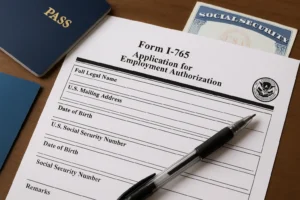
- Alongside I-485, most applicants also file Form I-765 (work authorization) and Form I-131 (advance parole for travel), since those benefits take months to approve independently.
- USCIS schedules a biometrics appointment to collect fingerprints, photo, and signature for background checks.
- If documentation is incomplete or unclear, USCIS issues a Request for Evidence (RFE). Respond thoroughly and on time, delays here can set your case back by months.
- The couple attends a marriage-based interview at a local USCIS field office. If approved, the green card is issued.
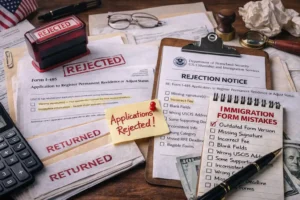
Errors in form edition, missing signatures, incorrect fee amounts, or incomplete answers are the most common reasons packets get rejected before USCIS ever reviews the merits. Our immigration form preparation services are designed to help you submit a complete, organized packet so that preventable issues never become your problem.
Consular Processing (When the Spouse Is Abroad)
When the immigrating spouse is outside the U.S., or is in the U.S. but ineligible to adjust status, the case proceeds through consular processing:
- The U.S.-based spouse files Form I-130 with USCIS to start the petition.
- After USCIS approves the petition, the case transfers to the National Visa Center (NVC), which collects fees and supporting documents before scheduling the interview.
- The immigrant spouse completes Form DS-260 (immigrant visa application online) and uploads civil documents, birth certificates, police certificates, and marriage records.
- The immigrant spouse attends a medical examination with an approved panel physician in their country.
- The NVC schedules an immigrant visa interview at the appropriate U.S. embassy or consulate.
- If approved, the spouse enters the U.S. using their immigrant visa. After paying the USCIS immigrant fee, the physical green card arrives by mail.
Every foreign-language document submitted to USCIS or NVC must be accompanied by a full, certified English translation. Our certified document translation service produces translations that meet USCIS format requirements, because an improperly formatted translation is grounds for rejection, not just a minor inconvenience.
Required Forms and Documents for a Marriage Green Card
The combination of forms you need depends on whether you are adjusting status in the U.S. or processing through a consulate abroad. Below is a summary of the most common forms:
| Form | Filed By | Purpose | When Used |
| I-130 | Petitioning spouse | Establish qualifying relationship | All marriage cases |
| I-130A | Immigrating spouse | Additional background information | Usually with I-130 |
| I-485 | Immigrating spouse (in U.S.) | Apply for permanent residence | Adjustment of status |
| I-864 | Sponsor / joint sponsor | Affidavit of financial support | All family-based cases |
| I-693 | Civil surgeon | Medical exam report | Adjustment of status |
| I-765 | Immigrating spouse (in U.S.) | Work permit while I-485 is pending | Optional but recommended |
| I-131 | Immigrating spouse (in U.S.) | Advance parole for travel | Optional but recommended |
| DS-260 | Immigrating spouse abroad | Immigrant visa application | Consular processing |
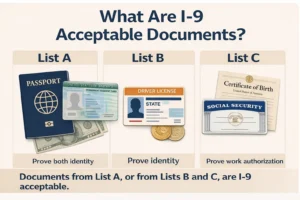
Beyond forms, you will need identity and civil documents: passports, birth certificates, your marriage certificate, and divorce decrees from any prior marriages for either spouse. Evidence that your marriage is bona fide should include:
- Joint bank account or credit card statements
- Shared lease or mortgage documents in both names
- Utility bills and insurance policies listing both spouses
- Photos together over time, family gatherings, travel, everyday moments
- Travel records and boarding passes for trips taken together
- Documentation of shared responsibilities such as children’s school records or joint memberships
Some of these documents may require notarization before submission. Our document notarization service handles that in compliance with Florida and federal standards. The goal with your evidence package is not volume, it is clarity. Organized, labeled documents tell a coherent story; a pile of unsorted pages does not.
Marriage Green Card Interview: What USCIS Asks and How to Prepare
The interview is the government’s in-person opportunity to confirm what you submitted and assess whether the relationship holds up under direct questioning. Whether it is at a USCIS field office or a U.S. embassy, the structure follows a recognizable pattern.
Officers typically start with basics, names, dates of birth, address history, current employment, before moving to the relationship timeline: how you met, how things progressed, the proposal, the wedding, who attended. From there, questions shift to shared daily life: who wakes up first, how you divide chores, where you spent the last holiday, who manages the bills, what your plans are as a couple. These questions are designed to reveal whether you are genuinely building a life together or have memorized a story.
In cases where there are red flags, large age differences, very short courtships, or contradictory statements in the record, the officer may separate the couple and interview each independently. This is called a Stokes interview. If you have reason to expect that level of scrutiny, speaking with a licensed immigration attorney before the appointment is strongly advised.
Practical preparation includes reviewing your forms together beforehand, walking through your relationship timeline out loud, bringing updated evidence (recent photos, new financial records), and having original documents organized so you can find anything quickly. An orderly, labeled folder makes a visible difference when an officer asks for a specific document in the middle of an interview.
Conditional vs. Permanent Green Card: Removing Conditions With Form I-751
If USCIS approves your green card within two years of your wedding date, you receive a conditional green card, valid for two years. This conditional status exists to deter fraudulent marriages by requiring couples to prove, after time has passed, that the relationship is still real. If you have been married for more than two years at the time of approval, you receive a standard 10-year green card with no conditions to remove.
For conditional residents, there is a strict deadline. During the 90-day window before the conditional card expires, you and your spouse must jointly file Form I-751 (Petition to Remove Conditions on Residence). This filing requires updated evidence of your ongoing marriage: joint tax returns, bank statements, lease agreements, insurance policies, and other documentation from the preceding two years.
There are limited exceptions that allow you to file I-751 without your spouse, in cases of divorce, documented abuse, or extreme hardship. These situations are legally complex and require attorney guidance. Failing to file on time can mean the termination of your conditional resident status and the start of removal proceedings. Many couples set a calendar alert 90 days before the card’s expiration date and begin assembling evidence well in advance.
If your family also needs support navigating benefit programs or documentation for children during this period, our children and family assistance service may be a useful resource alongside your immigration process.
Marriage Green Card Timeline and Processing Times in 2026
There is no universal timeline. In 2026, how long your case takes depends on whether your sponsor is a citizen or LPR, whether you are adjusting or processing through a consulate, which USCIS service center or field office handles your petition, and, if you are abroad, the workload at your specific embassy or consulate.
USCIS publishes updated processing time estimates by form and office on its official Case Processing Times page. Use that tool directly rather than relying on forum posts or outdated blog articles. For spouses of U.S. citizens going through adjustment of status, most cases are currently taking well over a year from filing to green card. Spouses of LPRs typically wait longer, especially while waiting for a current priority date in the Visa Bulletin.
The variables within your control are straightforward: use the correct, current edition of every form; answer all required questions completely; submit a well-organized supporting document packet; and respond to any Requests for Evidence immediately and thoroughly. Incomplete or incorrectly prepared applications are one of the primary reasons cases get delayed, something that administrative preparation can directly prevent.
Total Costs and Filing Fees for a Marriage-Based Green Card
There is no flat fee for a marriage-based green card. Costs accumulate across USCIS filing fees for each form, the immigration medical exam, certified translations, notarizations, shipping, and any professional services you engage.
USCIS fees are updated through official rulemaking and can change with little public notice. Always verify current amounts using the USCIS Fee Calculator and Form G-1055 before submitting any payment. Sending the wrong fee, even by a small amount, will result in your application being returned, setting your timeline back by weeks.
For consular processing cases, budget for travel to the city where the U.S. embassy or consulate is located, plus lodging if needed for the medical exam and interview. When you add up filing fees, medical costs, translations, notarizations, travel, and professional services, the total investment for a marriage-based green card case can be substantial. Mapping out your expected costs before filing helps you prepare and avoids scrambling when bills arrive together.
Final Thoughts: Getting Professional Support With Your Marriage Green Card
A marriage-based green card affects where you live, how you can work, and how secure your future together feels. Understanding who qualifies, how the process works, what the difference between visa categories means, and what the conditional card requires puts you in a much stronger position to navigate it.
No article, no matter how detailed, replaces personalized legal advice. If you have immigration violations, prior fraud findings, criminal history, or any factor that complicates your admissibility, a licensed immigration attorney is the right first call. For those questions, there is no substitute for qualified legal counsel.
If the challenge is the paperwork itself, keeping track of forms, gathering documents, getting translations, making sure every field is complete, YT Multiservices is built for exactly that. We support you with immigration form preparation, certified document translation, document notarization, and organized packet assembly, all under your direction, while you work with a legal professional for strategy decisions.
When the paperwork is solid, the process moves. Reach out to schedule a consultation and take the next step with confidence.