Applying for a Green Card is one of the most important steps in the immigration journey toward permanent residency in the United States. Whether you are married to a U.S. citizen or currently living in the U.S. under a valid visa, understanding which Green Card pathway applies to you—and how to prepare your application correctly—is essential. While the process may appear straightforward at first glance, it involves multiple forms, supporting documents, government fees, eligibility rules, and in some cases, an in-person interview with USCIS. A single error or missing document can delay or even jeopardize your approval.
In 2025, the two most common ways people apply for a Green Card are through marriage or by filing an Adjustment of Status application (Form I-485) from inside the United States. These two pathways often overlap, as many marriage-based applicants already reside in the U.S. on temporary visas such as F-1 student status, tourist visas, or work permits. While USCIS provides clear guidelines, many applicants become overwhelmed when attempting to understand how Form I-130, Form I-485, Form I-864, and biometrics appointments all fit together. Others mistakenly follow outdated instructions online or file incorrect versions of required forms, resulting in delays or Requests for Evidence (RFEs).
This guide is designed to simplify the process. You will learn who qualifies, which application process applies to your situation, which documents are required, how long it takes, and how to avoid common mistakes that slow down Green Card approval. Although USCIS ultimately makes the final decision, the accuracy and organization of your application play a major role in how smoothly your case progresses. That is why many applicants choose to use professional immigration form preparation services like YT Multiservices to ensure their documentation is complete, consistent, and properly formatted before submission.
Who Can Apply for a Green Card?
There are multiple categories through which individuals can apply for a Green Card, but family-based immigration remains the most common path, particularly through marriage to a U.S. citizen or permanent resident. A U.S. citizen can petition for their spouse, parents, or unmarried children under 21 with relatively faster processing times compared to other family categories. Lawful permanent residents (Green Card holders) can also petition for spouses and unmarried children, although waiting times may be longer due to visa availability limits.
While this article focuses on marriage and adjustment of status, it’s helpful to understand that Green Cards are also available through employment sponsorship, asylum or refugee status, Special Immigrant categories, and diversity visa lottery. However, most of these alternatives involve more restrictive qualifications, employer sponsorship commitments, or limited lottery chances. By comparison, marriage-based Green Cards provide one of the most straightforward and direct pathways to permanent residency, provided that the marriage is legitimate and properly documented.
It’s also important to understand the difference between applying from inside the U.S. versus applying from abroad. If the applicant is currently living in the U.S. legally, they may qualify for Adjustment of Status (AOS), allowing them to apply without leaving the country. On the other hand, if they are outside the U.S., they must go through Consular Processing at a U.S. embassy or consulate in their home country. Choosing the correct route is crucial, as applying through the wrong process may result in denial or delayed approval.
Green Card Through Marriage: Two Different Paths
Marriage to a U.S. citizen or lawful permanent resident is one of the most common and direct ways to obtain a Green Card. However, the application process depends entirely on where the foreign spouse is currently living. USCIS recognizes two distinct pathways for marriage-based Green Cards:
- Applying from inside the United States, through Adjustment of Status (AOS)
- Applying from outside the United States, through Consular Processing
Understanding the difference between these two pathways is essential, as they involve different forms, interview locations, timelines, and risks. Applying through the wrong process—or misunderstanding eligibility requirements—can lead to unnecessary delays or even denial.
Applying from Inside the U.S. (Adjustment of Status – Form I-130 + I-485)
If the foreign spouse is already lawfully present in the United States, even on a temporary visa such as a tourist visa, student visa, or work visa, they may be eligible to apply for a Green Card without leaving the country. This process is known as Adjustment of Status (Form I-485). In most cases, the U.S. citizen spouse will file Form I-130 (Petition for Alien Relative) and the foreign spouse will submit Form I-485 at the same time—a process referred to as “concurrent filing.”
One of the primary benefits of Adjustment of Status is that the applicant can remain in the United States throughout the process, even if their temporary visa expires while their case is pending. Additionally, applicants may be eligible to receive a work permit (EAD – Employment Authorization Document) and advance parole (travel document) while awaiting their Green Card approval. These benefits allow spouses to work legally and travel internationally before final approval.
However, USCIS carefully reviews marriage-based Adjustment of Status applications to detect fraudulent or convenience-based marriages. Couples must provide compelling evidence that their relationship is genuine, such as joint leases, bank accounts, utility bills, photographs, and affidavits from friends or relatives. Failure to submit sufficient proof of a bona fide marriage often results in a Request for Evidence (RFE) or interview complications.
Applying from Outside the U.S. (Consular Processing)
If the foreign spouse lives abroad or does not qualify for Adjustment of Status inside the U.S., the correct procedure is Consular Processing. In this pathway, the U.S. citizen or permanent resident spouse files Form I-130, and once USCIS approves it, the case is forwarded to the National Visa Center (NVC). From there, the applicant must complete Form DS-260 and attend an in-person interview at a U.S. embassy or consulate in their home country.
Consular Processing generally moves faster than Adjustment of Status in some cases, especially for spouses of U.S. citizens. However, it does not allow the foreign spouse to enter or remain in the U.S. during the process unless they obtain a temporary visa separately. Another key difference is that there is no access to a work permit or advance parole during processing, as approval must be granted before entry into the country as a permanent resident.
While Consular Processing avoids concerns about overstaying or unlawful presence inside the U.S., it carries one notable risk: if the applicant is denied at the interview, they may face prolonged separation from their spouse while reapplying. Therefore, preparing complete and well-organized documentation—including proof of marriage authenticity—is essential to avoid complications.
Documents You Must Submit to Prove a Real Marriage
USCIS places significant emphasis on proving the legitimacy of the marriage, regardless of whether you apply through Adjustment of Status or Consular Processing. Submitting only a marriage certificate is not enough. USCIS requires evidence of a shared life, which may include:
- Joint bank accounts, credit cards, or tax returns
- Leases or mortgage documents with both names
- Utility bills with shared address
- Life insurance or health insurance policies listing each spouse as beneficiary
- Photos together over time, especially with family or at major events
- Travel records or boarding passes from trips taken together
- Birth certificates of children born into the marriage (if applicable)
Providing thorough, well-labeled evidence significantly improves trust in the application. In contrast, submitting disorganized or minimal proof increases the likelihood of RFEs or extended questioning during the interview. Accuracy and presentation play a meaningful role in USCIS decision-making.
Adjustment of Status (Form I-485): How It Works Step by Step
Adjustment of Status (AOS) is the process that allows eligible applicants already living in the United States to apply for a Green Card without leaving the country. This option is commonly used by spouses of U.S. citizens, but it is also available to certain employment-based and humanitarian applicants. Understanding the correct procedural order is essential, as filing the wrong forms—or filing them in the wrong sequence—can result in immediate rejection.
Who Qualifies for Adjustment of Status Inside the U.S.?
To qualify for Adjustment of Status, the applicant must generally meet three key requirements:
- Be physically present in the United States at the time of filing.
USCIS will not accept an AOS application filed from outside the country. - Have entered the U.S. legally.
Most applicants must have entered with a valid visa or inspection by a border officer, such as with a tourist, student, or work visa. Even if the visa later expired, eligibility may still apply as long as the original entry was lawful. - Have a qualifying relationship or eligibility category.
This includes marriage to a U.S. citizen, approved employment sponsorship, asylum/refugee approval, or other limited categories. Spouses of U.S. citizens are given special consideration, even if they have overstayed a visa.
Applicants who entered illegally or without inspection may not qualify for Adjustment of Status and might instead require Consular Processing combined with a waiver, which is a more complex process. Therefore, verifying eligibility before filing I-485 is essential to avoid denial.
Required Forms, Fees, and Supporting Evidence
Adjustment of Status typically involves multiple forms submitted together in a single application packet. For marriage-based cases, the most common concurrent filing package includes:
| Form | Purpose |
| Form I-130 | Establishes the qualifying family relationship (e.g., marriage) |
| Form I-485 | Application to Adjust Status to Permanent Resident |
| Form I-864 | Affidavit of Support, Proof that the U.S. sponsor can financially support the applicant |
| Form I-693 | Medical Exam (Effective Dec. 2, 2024, you must submit Form I-693, or a partial Form I-693, such as the Vaccination Record, and you must submit it with your Form I-485. Otherwise, your Form I-485 could be rejected.) |
| Form I-765 (optional) | Work Permit request while waiting |
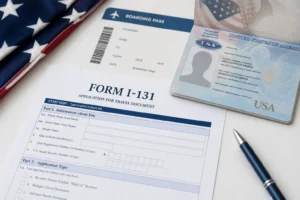
| Form I-131 (optional) | Advance Parole, permission to travel outside the U.S. while case is pending |
Each form carries separate filing fees, and USCIS periodically updates fee schedules. Failure to use the correct versions of the forms—or miscalculating payment—can lead to rejection before the case is even reviewed. In addition, applicants must include passport-style photos, proof of lawful entry (I-94 record), marriage certificate, identification documents, and evidence of a bona fide relationship.
Submitting a well-organized application not only expedites review but also demonstrates credibility. USCIS officers routinely flag disorganized or incomplete applications for further scrutiny, which may delay processing or trigger a Request for Evidence (RFE). Many applicants choose to work with document preparation services like YT Multiservices to ensure accuracy before filing.
Interview and Work Permit While Waiting
Most marriage-based Adjustment of Status applicants are required to attend an in-person interview at a local USCIS field office. During this interview, both spouses must appear and answer questions about their relationship, living arrangements, and future plans. The officer may also review previously submitted documents or request additional proof such as photographs or joint accounts. Providing consistent, confident answers is essential, as discrepancies may cause delays or suspicion of fraud.
While waiting for the Green Card decision, applicants who filed Form I-765 (Work Permit) can receive temporary employment authorization, allowing them to work legally in the United States before final approval. If Form I-131 (Advance Parole) was submitted, they may also travel abroad and reenter without abandoning the application. However, travel should be avoided if the applicant has previous immigration violations or unlawful presence, as it may trigger inadmissibility complications at reentry.
On average, Adjustment of Status processing times range from 8 to 18 months, although this varies by state and USCIS workload. Applicants who prepare thoroughly tend to experience fewer setbacks and receive approval more smoothly. Filing correctly from the beginning is often the determining factor between a straightforward case and a prolonged one.
Green Card Costs and Processing Times in 2025
Applying for a Green Card involves not only careful documentation but also financial planning. While the emotional value of permanent residency is immeasurable, applicants should understand the current USCIS filing fees and processing timelines, which may vary depending on where and how they file.
Government Filing Fees (Based on the Current USCIS Fee Schedule)
For most marriage-based Adjustment of Status applicants filing from inside the U.S. (Form I-485), the general filing fee is currently $1,440, according to the latest USCIS fee schedule. However, it’s important to understand that:
- Form I-485 (Adjustment of Status): $1,440
- Biometrics: May already be included depending on age and filing category
- Form I-130 (Petition for Alien Relative): $675 paper/625 online fee
- Form I-765 (Employment Authorization / Work Permit) and Form I-131 (Advance Parole / Travel Permit)
- These were previously included at no extra cost when filed with I-485, but under the 2024 Final Fee Rule, they now often require separate filing fees, depending on age and filing category.
Because USCIS updates fees periodically, applicants should verify the correct amounts using the official USCIS Fee Calculator before submitting payment. Filing with the wrong amount—or using outdated forms—can lead to immediate rejection before the case is even reviewed.
For applicants filing from outside the U.S. through Consular Processing, the fees are paid in stages through USCIS and the National Visa Center (NVC), followed by DS-260 consular application fees, medical examination costs, and embassy interview preparation expenses. While the total cost is often similar to Adjustment of Status, the timing and structure of payments are different.
Processing Times in 2025
While USCIS continues to improve digital processing tools, Green Card timelines remain unpredictable. On average:
| Application Type | Estimated Processing Time (2025) |
| Marriage-Based Adjustment of Status (inside U.S.) | 8–18 months |
| Marriage-Based Consular Processing (outside U.S.) | 10–20 months |
| Other Family-Based Categories | 1–5 years depending on visa availability |
These estimates may increase if USCIS requests additional documentation or if errors are made during filing. Many delays occur not because the applicant is ineligible—but because paperwork is incomplete, incorrectly formatted, or missing key evidence.
However, USCIS does not guarantee fixed timelines. To obtain the most accurate estimate for your specific case, USCIS provides an official Processing Times Tool.
Applicants should check this tool based on their specific form and local field office, as some locations process cases more quickly than others.
Common Reasons Green Card Applications Get Delayed or Denied
Many Green Card applications are delayed or denied not because the applicant is ineligible, but due to avoidable mistakes made during filing. Understanding the most common errors can help applicants prepare more effectively and avoid unnecessary setbacks.
One of the primary reasons for delays is insufficient documentation or disorganized evidence. USCIS officers must be able to quickly verify eligibility and relationship authenticity. When required documents are missing, mislabeled, or unclear, USCIS will often issue a Request for Evidence (RFE), which can pause a case for several months. This is especially true for marriage-based applications, where proof of a bona fide relationship must be strong and consistent. Submitting only a marriage certificate without supporting relationship history is one of the most frequent causes of questioning or interview scrutiny.
Another common issue is inconsistent or inaccurate information across forms. USCIS cross-references all answers across multiple documents, including past visa applications, prior entries to the U.S., and personal history. Even minor discrepancies, such as incorrect entry dates, mismatched addresses, or conflicting employment records, can raise concerns and slow down adjudication. Applicants should thoroughly review their Form I-130, I-485, and any supporting forms to ensure all answers match previous immigration records. If a correction is needed, it is better to address it proactively than to wait for USCIS to flag it.
A third frequent problem occurs when applicants submit the wrong edition of USCIS forms or incorrect filing fees. USCIS updates many immigration forms several times a year, and filing with outdated versions can lead to immediate rejection. Similarly, submitting the wrong fee, even by a few dollars, may result in the entire package being sent back without processing. Because of this, many applicants choose to prepare their filing packets with professional assistance to ensure that forms, evidence, and payments comply with the latest USCIS standards.
Can You Apply for Work or Travel While Waiting for Your Green Card?
Yes, most applicants filing for Adjustment of Status inside the United States are eligible to request temporary work and travel authorization while their Green Card application is pending. This is done through two additional forms that can be filed together with Form I-485:
| Form | Purpose | Processing Benefit |
| Form I-765 | Employment Authorization Document (EAD) | Allows you to work legally in the U.S. while waiting for your Green Card |
| Form I-131 | Advance Parole | Allows you to travel internationally and re-enter without abandoning your case |
Once approved, the EAD (work permit) is typically valid for one to two years and can be renewed if your case remains pending. Advance Parole, on the other hand, permits temporary travel outside the U.S., but applicants with a history of unlawful presence or immigration violations should consult with an expert before traveling, as re-entry is not guaranteed in every situation.
Applicants going through Consular Processing outside the U.S. are not eligible for work or travel permission until after their immigrant visa is approved and they physically enter the U.S. as permanent residents.
Do You Need a Lawyer to Apply for a Green Card?
USCIS does not require applicants to hire an immigration lawyer. Many people successfully obtain their Green Card without legal representation, especially in straightforward family-based cases such as marriage to a U.S. citizen. However, this does not mean that preparing the application is simple. Most delays and rejections occur not because someone is ineligible, but because their forms are incomplete, outdated, or inconsistent with USCIS requirements.
A lawyer may be necessary in complex situations such as:
- Past immigration violations (overstays, unlawful entry, deportation orders)
- Criminal history or prior visa fraud concerns
- Cases involving inadmissibility waivers
But for applicants with clean records and simple eligibility, many choose a more affordable and efficient solution, professional immigration form preparation services.
Apply with Confidence, YT Multiservices Can Help You File Correctly
Applying for a Green Card is a major milestone, but it does not have to be overwhelming. Whether you are applying through marriage or adjusting your status from inside the United States, a single mistake on your paperwork can delay your approval for months. USCIS does not refund filing fees, and re-filing due to rejection can quickly become stressful and expensive. That’s why many applicants turn to YT Multiservices, a trusted provider of immigration document preparation. Our team helps you complete the correct USCIS forms, including I-130, I-485, I-765, I-131, and I-864, while also ensuring your supporting evidence is properly organized and presented in a clear, professional format ready for review. By preventing errors such as missing signatures or outdated form versions, we help you avoid unnecessary delays and move confidently toward approval. You focus on your future, we’ll handle the paperwork. If you’re ready to begin your Green Card journey, contact YT Multiservices today and let us prepare your application the right way, the first time.