Form I-130, officially known as the Petition for Alien Relative, is the first step a U.S. citizen or lawful permanent resident takes to request permanent residency for a family member. Its approval is essential for the beneficiary to continue the immigration process, whether through Adjustment of Status within the U.S. or Consular Processing abroad. However, one of the most common questions immigration advisors receive is: How long does it actually take for USCIS to approve this form?
Throughout 2025, I-130 processing times continue to show significant variations depending on multiple factors. Not all cases move at the same pace, the office handling the petition, the family category, and USCIS’s overall workload all play a role. Administrative changes and periods of increased case backlogs also have a direct impact.
That’s why, instead of focusing on a single number, it’s more useful to understand the range of possible timelines and how to check the progress of your specific case. Having up-to-date information and realistic expectations helps reduce the anxiety that often accompanies immigration procedures and allows for better planning of the next steps.
In this article, we’ll explain in detail the factors that determine Form I-130’s processing time, how to check your status step by step, and what to expect once your petition is approved. We’ll also show how YT Multiservices can help you avoid delays and keep your case organized from day one.
What Is Form I-130 and Why Processing Times Vary
The main purpose of Form I-130 is to establish a legitimate family relationship between the petitioner and the beneficiary. It serves as proof to USCIS that the relationship is real and meets all legal requirements for applying for permanent residence. Without this step, no family member can be included in family-based immigration processes.
The time it takes to process this form varies widely, mainly due to the different family categories recognized under U.S. immigration law. A petition filed by a U.S. citizen for a spouse is not the same as one filed by a lawful permanent resident for an adult child. Each relationship type belongs to a different category, and each has its own approval rate and demand.
Another key factor is which USCIS service center receives and reviews the case. USCIS operates several centers across the country, each with different workloads. Some offices are more backlogged than others, meaning two nearly identical petitions can have outcomes that differ by several months.
Accuracy also matters. If documents are missing, information contains errors, or the evidence of the family relationship is insufficient, USCIS may issue a Request for Evidence (RFE), which can significantly extend the process. For that reason, submitting a complete and accurate application from the start is crucial to avoid unnecessary delays.
Current I-130 Processing Times: Typical Ranges You’ll See
As of early 2025, the average processing times for Form I-130 vary depending on the family relationship and the petitioner’s immigration status. For U.S. citizens filing for a spouse, minor child, or parent (immediate relatives), the most recent analysis places the approval time at approximately 14 to 15 months.
In contrast, when the petitioner is a lawful permanent resident filing for a spouse or minor child, the I-130 process can take significantly longer because the category is subject to annual visa limits. Some analyses report ranges of 55 to 89 months or more just for the approval of the petition itself.
For the family preference categories (“F”) such as adult children of U.S. citizens or siblings of U.S. citizens, processing times expand considerably. The approval of the I-130 alone may take several years, and after approval, beneficiaries must still wait for a visa number to become available based on the priority date. Some reports estimate 4 to 10 years or more, depending on the country of origin.
It is important to remember that the processing times published by USCIS are estimates based on 80 percent of cases, not guarantees for any specific petition. For this reason, comparing timelines with other applicants is not useful, as each case follows its own path.
Finally, USCIS updates its processing time tables every month, so checking them regularly can help you maintain a more realistic understanding of your case progress and better plan your next steps.
How to Check Your I-130 Processing Time Step by Step
Understanding what stage your application is in is one of the best ways to stay calm and prepared throughout the process. USCIS provides an online tool that lets you check average processing times by form and office. Here’s how to use it effectively:
• Step 1: Find Your Form, Category, and Office in the USCIS Processing Times tool
- Go to the official USCIS Processing Times tool.
- Select Form I-130 (Petition for Alien Relative).
- Then, choose your petition category based on the relationship type (for example, “U.S. citizen filing for a spouse, parent, or child under 21” or “Permanent resident for unmarried son or daughter 21 or older”).
- Finally, select the service center listed on your USCIS receipt notice (Form I-797C, Notice of Action).
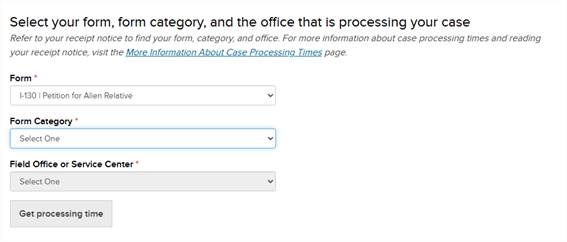
It’s important to enter all three details accurately since times vary significantly by office and category. You can find your assigned center on your receipt notice.
We recommend saving the link or taking a screenshot so you can compare times later and track changes.
• Step 2: Read the “Case Inquiry Date” and Understand Its Meaning
Once the system displays the processing range, you’ll also see a “Case Inquiry Date.”
This date marks the point at which USCIS allows you to inquire about delayed cases. If your petition was filed before that date and you haven’t received a decision, you may contact USCIS for an official update.
If your case was filed after that date, it’s still within normal processing time. This date changes monthly, so checking it periodically helps you know when your case becomes eligible for inquiry and prevents unnecessary worry.
• Step 3: Set Realistic Expectations and Calendar Reminders
After identifying your time range and inquiry date, set reminders in your calendar, for example, once a month, to recheck your case’s progress. This approach helps you stay informed without obsessively checking daily.
Remember that immigration processing times are not exact. Even if your case seems slower than others, that doesn’t necessarily indicate a problem. Each application goes through various internal stages, and some offices process in batches or by priority. Staying patient, organized, and informed will help you manage the wait more comfortably.
Also, keep every USCIS email and notice you receive, they contain key details like your receipt number, assigned center, and filing date. These documents are vital for online status checks and formal inquiries if your case goes beyond typical processing times.
Immediate Relatives vs. Family Preference: Why It Matters
U.S. immigration law divides family-based petitions into two main groups: immediate relatives and family preference categories. Understanding this distinction helps explain why some cases move faster than others.
Immediate relatives include spouses, parents, and unmarried children under 21 of U.S. citizens. These petitions are not subject to annual visa limits, meaning that once USCIS approves the I-130, the process can continue without waiting for visa availability. As a result, these cases tend to be faster and more predictable.
Family preference categories, on the other hand, include adult and married children, siblings of U.S. citizens, and the spouses or children of lawful permanent residents. These are subject to annual visa quotas per country, which creates backlogs that can last several years, especially for nations with high demand like Mexico, the Philippines, India, and China.
Knowing which group your case belongs to helps you manage your expectations realistically. It’s not that one case is more important than another, it’s simply how the immigration system operates. Keeping track of the U.S. Department of State’s Visa Bulletin is just as important as monitoring USCIS timelines.
AOS vs. Consular Processing Time
Total processing time also depends on where the beneficiary is located when applying.
If they are inside the United States, they may apply through Adjustment of Status (AOS), submitting Form I-130 together with Form I-485 (Application for Permanent Residence). This concurrent filing can make the process more efficient since some stages are handled simultaneously.
If the beneficiary is outside the U.S., the case proceeds through Consular Processing. After USCIS approves the I-130, the case is transferred to the National Visa Center (NVC) for financial and documentary review before being sent to the appropriate U.S. consulate. This stage may add several more months, particularly if there are appointment delays or missing documents.
Both paths are valid but operate differently. AOS allows the applicant to remain in the U.S., while consular processing is mandatory for those living abroad. Choosing the best strategy depends on your specific situation, and professional guidance can make a significant difference.
Factors That Speed Up or Slow Down Your I-130
Each immigration case is unique, and timelines can vary even between nearly identical applications. The most common causes of delay include incomplete or incorrect forms and missing evidence. USCIS reviews all details carefully, and any inconsistency can trigger an RFE (Request for Evidence).
Other influences include USCIS internal policies, administrative changes, or sudden surges in application volume. Temporary office closures, emergencies, or staffing transitions can also affect timelines.
Maintaining clear communication with USCIS helps too, updating your contact information, responding promptly to notices, and keeping organized copies of all submissions can prevent miscommunication and unnecessary slowdowns.
Can You Expedite an I-130?
In limited situations, you can request an expedite or accelerated review. USCIS only grants these in exceptional cases, such as severe medical emergencies, urgent humanitarian situations, or compelling family reunification needs under special circumstances.
However, expedited approval is not guaranteed. Each request is reviewed individually and granted at USCIS’s discretion. Even when an expedite is requested, many cases still follow the normal process.
The most effective way to “speed up” your petition remains the same: submit a complete, well-documented, error-free application from the start. Strong evidence and accurate information are the best tools to prevent unnecessary delays.
If you believe your case may qualify for an expedite request, seek professional assistance to properly prepare the documentation and justification.
After I-130 Approval, What Happens Next
Receiving an I-130 approval notice is an exciting milestone, but it’s not the end of the process. What comes next depends on where the beneficiary resides.
If they’re in the U.S., the next step is usually filing Form I-485 (Adjustment of Status) to apply for permanent residency without leaving the country.
If they’re abroad, the case is transferred to the National Visa Center (NVC). There, financial documents are collected, additional forms such as the DS-260 are completed, and consular fees are paid. Once the NVC confirms everything is in order, the case is forwarded to the appropriate U.S. consulate for the visa interview.
This stage can add several more months depending on the consulate’s workload. It’s essential to monitor your email and NVC notifications closely, missed responses can cause delays. Keeping all documents up to date, translated, and organized will help you move smoothly through the final steps.
In short, I-130 approval marks the beginning of a new phase, not the end. Staying informed and working with professionals can save time and stress in this decisive stage.
How YT Multiservices Helps You Avoid Delays
At YT Multiservices, we understand how meaningful every family petition is. Behind each form are families hoping to reunite, couples seeking stability, and individuals trusting the U.S. immigration system to build a better future. Our mission is to guide you through each step, helping you avoid mistakes and simplifying the process.
Our team assists with complete I-130 preparation, ensuring that all information is accurate and that your supporting evidence meets USCIS requirements. We also offer certified translation and notarization services, essential for submitting valid evidence to immigration authorities.
Additionally, we provide personalized guidance on processing times, family categories, and next steps after approval, so you can move forward confidently, knowing your case is properly prepared from the start.
At YT Multiservices, we believe that a successful immigration process begins with a well-prepared application. If you need help completing your forms or understanding your case timeline, contact us today and let us help you reach your goals without unnecessary setbacks.
Frequently Asked Questions About I-130 Processing Times
Even though Form I-130 is one of the most common immigration forms, there are still many doubts about waiting times and possible variations. Below are the most frequently asked questions from applicants waiting for their family petitions to be approved.
• How often do processing times change, and where can I find the most recent information?
Processing times are not fixed, USCIS updates them monthly based on the latest data from each service center. This means the timeline you see today might change next month as workloads shift. Always verify information regularly using the official USCIS Processing Times tool at egov.uscis.gov/processing-times. Checking once a month is a good habit that helps you stay informed and manage expectations.
• Why did my friend’s case get approved faster?
Each case is unique. Even if two petitions were filed the same day, their timelines can differ due to the relationship type, service center, or whether USCIS requested additional evidence. Cases with complete documentation often move faster, while those with RFEs (Requests for Evidence) take longer. Instead of comparing, focus on ensuring your own petition is accurate and well-supported.
• Does filing the I-130 with the I-485 affect processing time?
Yes. Filing Form I-130 together with Form I-485 (Adjustment of Status) can shorten the overall timeline because USCIS can process both simultaneously. However, this option only applies to beneficiaries lawfully present in the U.S. and eligible for adjustment. Those abroad must first complete I-130 approval before proceeding with consular processing.
• What if I move or change my email during the process?
Failing to update your contact information can cause serious delays or missed notifications. You must inform USCIS immediately through its Change of Address tool or by submitting Form AR-11. Also, check your inbox and spam folders regularly. Keeping your contact info current is one of the simplest ways to prevent unnecessary complications.
Conclusion
The Form I-130 processing time in 2025 remains a key concern for thousands of families waiting to reunite in the United States. While timelines can vary, being informed, submitting an accurate application, and keeping organized records are the best ways to move forward smoothly.
Remember, every case is different. Patience, preparation, and professional guidance are your strongest allies. Understanding the factors that influence timelines can make the difference between a smooth process and one filled with obstacles.
At YT Multiservices, we’re here to make your process clear, efficient, and secure. Our team can guide you, review your forms, and ensure every step is done correctly.
Your immigration journey deserves care and attention. Contact us today and take the next step with the confidence of having a committed team by your side, focused on the success of your petition.