Immigration parole is a specific U.S. immigration tool that allows the government to let someone enter or stay in the United States temporarily, case by case, for urgent humanitarian reasons or significant public benefit. People sometimes use the word “parole” casually, but in immigration it has a defined meaning and it is not the same as a visa, a green card, or a guaranteed pathway to long-term status. Understanding that difference matters, especially now that parole-related costs and procedures have been in the spotlight and updated through official announcements.
Because parole decisions are discretionary and often connected to time-sensitive emergencies, families and sponsors tend to focus on two practical questions: what paperwork will be needed and what expenses might arise at the moment parole is granted. A policy update can feel confusing when you are already managing medical records, travel logistics, identity documents, or urgent family circumstances, so the goal of this article is to explain the change in simple words and point you to the official pages you should always rely on for the most current guidance.
This is general information, not legal advice. YT Multiservices is not a law firm, and we do not provide legal advice or legal representation. What we do is help people prepare immigration-related forms, organize supporting documentation, and handle administrative details like notarizations and certified translations, so your submission is clean, consistent, and less likely to be delayed by avoidable issues.
If you are reading this because you are facing a deadline, a family emergency, or a travel-related decision, the safest mindset is to treat every fee and timing estimate as something that can change. USCIS and DHS publish updates, and processing times can vary by form type, category, and the office handling your request.
New Immigration Parole Fee
USCIS has publicly announced that it is implementing a new immigration parole fee required by the H.R. 1 reconciliation bill framework described in its official alert, and it explains when the fee must be paid and the general circumstances in which it applies. The key takeaway is that the fee is tied to the act of being paroled into the United States, meaning it is connected to the actual parole grant rather than simply the idea of “requesting parole.”
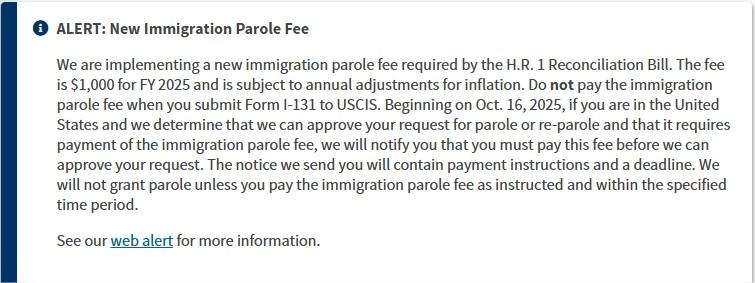
To avoid confusion, it helps to separate three different moments: when someone submits a request, when an agency reviews the request, and when parole is actually granted and carried out. The official notice explains that the fee is collected when parole is granted or effectuated, and it can apply even if a request was filed earlier, depending on when the parole event happens. This is one reason people can feel “caught off guard” if they assumed the rules at the time of filing would necessarily control everything later.
The Federal Register notice also clarifies that the fee requirement is connected to parole granted under the immigration parole authority referenced in the notice, and it describes how DHS components may handle collection depending on the situation. In everyday terms, that can mean the payment step may be associated with the point of entry process or with a post-decision instruction flow, rather than being something you automatically pay as the very first step.
USCIS also highlights this fee implementation in the context of Form I-131, which is the “Application for Travel Document,” often used in scenarios involving travel documents and certain parole-related requests. Even if your situation feels different from someone else’s, it is smart to use the official Form I-131 page as a reference point because USCIS places high-visibility updates there when something important changes.
One practical implication is that you should plan for the possibility that you may receive instructions or a deadline connected to payment after a favorable parole determination. The Federal Register notice discusses that parole is granted only after the fee is paid and describes consequences if the fee is not paid in time. This makes preparedness more important than ever, because missing a step can turn a hopeful moment into a preventable denial.
If you want to stay on the safest side of accuracy, do not rely on social media screenshots or old blog posts for fee amounts. USCIS may publish updates, and DHS describes the concept of adjustments over time, so the best habit is to check the official alert and the relevant USCIS form page right before you act. If you would like, YT Multiservices can help you prepare your paperwork so that when you confirm the current official instructions, you are ready to move without scrambling.
Exceptions to the $1,000 Parole Fee
The official Federal Register notice explains that there are enumerated statutory exceptions and that the parole fee will not be assessed if DHS finds, in its discretion, that the person has established they are being paroled under one of the listed exceptions. The language matters because it signals that exceptions are not automatic “labels”; they depend on what DHS determines based on the information presented.
Several exceptions relate to urgent medical realities, such as situations involving life-threatening medical emergencies where the person cannot obtain needed treatment in their country and there is not enough time to use the normal visa process. In these cases, the strongest practical approach is to focus on clear medical documentation and clean identity records that reduce doubts about who the records belong to and why the timeframe is truly urgent.
(1) The alien has a medical emergency and the alien cannot obtain necessary treatment in the foreign state in which the alien is residing; or the medical emergency is life-threatening and there is insufficient time for the alien to be admitted to the United States through the normal visa process
The notice also includes exceptions that reflect how emergencies often involve more than one person, including a parent or legal guardian accompanying a minor who is facing a life-threatening medical emergency. In real life, that means consistency in family relationship documents becomes especially important, because mismatched names, missing translations, or unclear custody/guardianship paperwork can create avoidable friction when time is already tight.
(2) The alien is the parent or legal guardian of an alien described in paragraph (1) and the alien described in paragraph (1) is a minor
Another exception referenced involves urgent organ or tissue donation needs, again tied to situations where waiting for standard processing would undermine the humanitarian purpose. When an exception is tied to a narrow medical circumstance, the documentation tends to carry the story, so medical letters, hospital records, and identification documents need to line up cleanly so the file reads quickly and credibly.
(3) The alien is needed in the United States to donate an organ or other tissue for transplant; and there is insufficient time for the alien to be admitted to the United States through the normal visa process
There are also exceptions connected to imminent death or funeral attendance for a close family member, reflecting a category of urgent family emergencies that do not fit neatly into “normal travel planning.” In these cases, the challenge is often proving the relationship and the urgency at the same time, which is why people frequently need correctly translated civil records and consistent family naming details across certificates and IDs.
(4) The alien has a close family member in the United States whose death is imminent; and the alien could not arrive in the United States in time to see such family member alive if the alien were to be admitted to the United States through the normal visa process;
(5) The alien is seeking to attend the funeral of a close family member; and the alien could not arrive in the United States in time to attend such funeral if the alien were to be admitted to the United States through the normal visa process
The notice includes a narrower exception involving an adopted child with an urgent medical condition, legal custody requirements, and the timeline pressure of an adoption-related visa process. Even if this does not apply to most readers, it illustrates a theme: exceptions are carefully defined and fact-specific, which is why you should avoid assuming that a situation is “close enough” without reviewing what the official notice actually says.
(6) The alien is an adopted child who has an urgent medical condition; who is in the legal custody of the petitioner for a final adoption-related visa; and whose medical treatment is required before the expected award of a final adoption-related visa
One exception that many families ask about relates to lawful applicants for adjustment of status who are returning to the United States after temporary travel abroad, a scenario often discussed in connection with advance parole travel documents. The Federal Register notice describes this as an exception category, which is why it is so important to avoid mixing up different “parole” scenarios in casual conversation, since the fee framework may treat them differently depending on the facts.
(7) The alien is a lawful applicant for adjustment of status under section 245 of the INA (8 U.S.C. 1255); and is returning to the United States after temporary travel abroad
Another exception described involves a person returned to a contiguous country under the cited immigration provision who is being paroled into the United States to attend an immigration hearing. This category is included as part of the statutory framework described in the notice, and it shows how parole can sometimes be used for a very specific procedural purpose rather than a broader humanitarian narrative.
(8) The alien has been returned to a contiguous country pursuant to section 235(b)(2)(C) of the INA (8 U.S.C. 1225(b)(2)(C)); and is being paroled into the United States to allow the alien to attend the alien’s immigration hearing
The notice also references Cuban and Haitian entrant status as defined in the cited Refugee Education Assistance Act reference, which is a defined statutory category. The point for most readers is not to self-diagnose eligibility, but to understand that the exceptions list is formal and limited, so the most reliable path is to match your facts to the official language and support that match with clean, organized records.
(9) The alien has been granted the status of Cuban and Haitian entrant (as defined in section 501(e) of the Refugee Education Assistance Act of 1980 (Pub. L. 96-422; 8 U.S.C. 1522 note)
Finally, the notice describes an exception connected to significant public benefit related to law enforcement assistance, where the person assisted or will assist the U.S. government and their presence is required in furtherance of that matter, and where normal admission is not feasible in time or due to admissibility constraints. This is another reminder that the exceptions are not “general hardship” categories; they are specific scenarios with specific factual hooks.
(10) The Secretary of Homeland Security determines that a significant public benefit has resulted or will result from the parole of an alien who has assisted or will assist the United States Government in a law enforcement matter; whose presence is required by the United States Government in furtherance of such law enforcement matter; and who is inadmissible or does not satisfy the eligibility requirements for admission as a nonimmigrant or for which there is insufficient time for the alien to be admitted to the United States through the normal visa process.
If you think an exception might apply, one of the most helpful administrative steps is to gather documents that prove identity, relationship, and urgency in a way that is easy to verify quickly. That may include certified translations for non-English civil documents, and it may include notarizations for supporting statements when appropriate. YT Multiservices can help you prepare that documentation package so it reads clearly without you having to juggle formatting, translations, and consistency checks alone.
Analysis and Impact of the New Parole Fee
A new parole fee affects more than budgets; it changes how people plan their timeline and their tolerance for uncertainty. Parole situations often involve short notice, urgent travel, or complicated family circumstances, so adding a required payment step at the parole moment can introduce a new logistical hurdle, especially for families who already have transportation and emergency-related costs to manage.
One of the biggest impacts is that the fee attaches at parole effectuation, meaning people with older pending requests can still be impacted if their parole grant happens after the effective date described in the official materials. That is why it is risky to rely on someone else’s timeline from last year, because two people can file at different times and still face different fee steps depending on when parole is actually granted.
The way the fee is collected can also vary depending on which DHS component is involved, and the Federal Register notice discusses roles for different agencies in different parole contexts. Practically, that means you may receive instructions that feel different from what you expected, and the “next step” after a favorable determination may require quick action to meet a deadline, which makes organization and readiness essential.
This is where administrative preparation becomes more than “nice to have.” If your supporting documents are scattered, names are inconsistent across records, or translations are missing, you can lose valuable time fixing issues when you should be ready to respond to official instructions. Clean, consistent paperwork does not guarantee an outcome, but it can reduce avoidable back-and-forth and help you meet time-sensitive requests without panic.
Processing times are another area where people commonly get misled by outdated information. USCIS itself emphasizes that processing times are estimates and vary, and the official processing times tool allows you to select a form, category, and office to see the current ranges. If you need a planning baseline, this tool is the safest reference point, and you should re-check it as your case moves forward because ranges can change.
Many families also need to track a case after filing, and official resources like USA.gov point people to the USCIS case status tools and explain what information you need to check your status. Using official tracking tools helps you avoid misinformation and helps you respond faster when an update arrives, especially when a time-sensitive fee or instruction is involved.
From a community perspective, the new fee may also shape how sponsors and beneficiaries communicate. People may feel pressure to move faster, borrow funds, or make travel decisions without a clear plan, and that is where a structured approach to paperwork can help reduce stress. Even if you cannot control agency timelines, you can control how prepared your file is and how quickly you can respond to official next steps.
If your documents are in another language, certified translations can become a make-or-break detail in how smoothly your file is reviewed. YT Multiservices offers certified translation services and notary support, which can help you avoid last-minute scrambling when you realize a record must be submitted in English or must be presented in a consistent format. This is the kind of practical, non-legal support that can make your process feel more manageable.
If you are trying to budget, the safest language is “fees can change and depend on the situation,” and the safest action is to confirm the current official fee guidance right before the parole moment, especially because USCIS has stated the fee is subject to adjustment. If you want help staying organized around those moving parts, you can contact YT Multiservices to review your paperwork for completeness and consistency so you are ready when you confirm the latest official instructions.
Key Takeaways
The new immigration parole fee is a real policy shift that changes planning at the moment parole is granted, and the official notices explain that the obligation is tied to parole effectuation rather than only to the initial act of filing. That difference matters because it means timing is not just about when you start; it can also depend on when a decision is carried out, which is why people should rely on official updates rather than secondhand assumptions.
The exceptions exist, but they are defined and limited, and DHS frames them as something you must establish to DHS’s satisfaction and that DHS applies in its discretion. In practical terms, that means your strongest move is documentation quality: clear identity records, consistent names and dates, and supporting evidence that makes your circumstances easy to understand without confusion or missing pieces.
Because USCIS fees and processing estimates can change, the safest habit is to verify current guidance close to the time you act, using official USCIS tools for processing ranges and official USCIS alerts for fee-related updates. When you want your paperwork to be ready before those checks, YT Multiservices can help you prepare a clean, organized submission package so you are not rushing at the worst possible moment.
Conclusion
The immigration parole fee update is one of those changes that can feel simple on paper but stressful in real life, because parole situations are often urgent and emotionally heavy. The best way to protect yourself from avoidable delays is to keep your documents consistent, your supporting records organized, and your expectations grounded in official sources rather than rumors. If you do that, you give yourself the best chance to respond quickly to instructions and reduce the “surprise factor” that creates panic.
If you want administrative support that stays in the right lane, YT Multiservices can help you prepare forms, organize and review supporting documents, notarize where appropriate, and provide certified translations so your file is clear and submission-ready. When you are ready, reach out and let us help you turn a stressful process into a structured plan you can actually follow with confidence.