Dreaming of living, working, studying, or starting fresh in the United States? You’re not alone and the first step starts with the right visa.
If you’re an ambitious student with a university acceptance letter, a skilled worker chasing a job opportunity, or an entrepreneur ready to invest in your future, choosing the correct U.S. visa can be the difference between moving forward or being stuck in paperwork limbo.
But with over a hundred visa categories and new rules and updates constantly rolling out, it’s easy to feel overwhelmed or even misinformed.
At YT Multiservices, we specialize in making U.S. immigration more understandable and more human. This updated 2025 guide breaks down the most important visa types in simple terms: who they’re for, how they work, and which path might be right for you or your loved ones.
Let’s clear the confusion and help you take the next step toward your American dream.
Nonimmigrant vs. Immigrant Visas: What’s the Difference?
Before diving into individual visa types, it’s essential to understand how U.S. visas are organized. All visas fall into one of two main categories, depending on your purpose and length of stay in the United States.
Nonimmigrant Visas – Temporary stays for specific purposes
Nonimmigrant visas are intended for people who want to visit or stay in the U.S. for a limited period of time. These visas are issued for specific purposes such as studying, working, attending a conference, receiving medical care, or participating in a cultural program.
The key feature of nonimmigrant visas is that they are not meant for permanent residence. While some allow you to change or adjust your status later, your initial intent must be temporary.
Here’s a quick look at some of the most common nonimmigrant visa types:
| Visa Type | Purpose | Duration | Notes |
| H‑1B | Skilled professionals | Up to 6 years | Lottery-based, limited spots available |
| F‑1 / M‑1 | Academic or vocational students | Program length + OPT | Eligible for STEM extension in some cases |
| J‑1 | Cultural or educational exchange | Varies | Some categories include a home return rule |
| L‑1 | Intra-company transfers | Up to 7 years | Dual intent allowed in many situations |
| E‑2 | Treaty-based business investment | 2 years, renewable | Requires active investment and business upkeep |
| B‑1 / B‑2 | Business or tourism | Up to 6 months | Cannot work or study in the U.S. |
Immigrant Visas – Pathway to Permanent Residency
Immigrant visas are for individuals who plan to move to the U.S. permanently. If approved, you’ll enter the country as a lawful permanent resident and receive a Green Card, giving you the right to live and work in the U.S. indefinitely.
There are four main ways to qualify for an immigrant visa:
- Sponsorship by a U.S. family member
- A qualifying employment offer
- A qualifying investment
- Selection in the Diversity Visa (DV) Lottery
Each of these paths comes with its own process, timelines, and eligibility criteria. Let’s now explore each in more detail.
Most Popular Nonimmigrant Visas
If you’re not planning to move permanently to the U.S. but instead want to study, work temporarily, or explore opportunities, then a nonimmigrant visa is likely what you need. While there are dozens of categories, some visas stand out for their popularity, demand, and flexibility in 2025.
H-1B Visa: For High-Skilled Workers in Specialized Occupations
This visa is ideal for professionals in fields like technology, healthcare, finance, and engineering. It requires a U.S. employer to file a petition on your behalf.
· Duration: Initially 3 years, renewable for a total of 6 years.
· Annual Cap: 65,000 general + 20,000 for holders of U.S. advanced degrees
· Benefits: “Dual intent” means you can apply for a Green Card while on H‑1B status.
F-1 Visa: Academic Student Pathway
The F-1 visa is designed for full-time students accepted at U.S. universities, language schools, and academic institutions.
· Work Options: Offers CPT, OPT, and 24-month STEM OPT extension for STEM students.
· New in 2025: U.S. authorities now require F, M, and J visa applicants to disclose social media handles and set their accounts to public as part of expanded security vetting
J-1 Visa: Exchange Visitors, Interns, and Scholars
The J-1 covers a wide range of programs, from interns, trainees, research scholars, au pairs, camp counselors, and more.
· Duration: Varies by program—ranging from weeks to several years.
· Two-Year Rule: Certain J-1 categories require a two-year home-country physical presence (Section 212(e)), unless a waiver is granted.
O-1 Visa: Extraordinary Ability
If you’ve received international recognition in your field, the O-1 may be for you.
- Eligibility: For individuals with demonstrated national or international acclaim in science, arts, education, business, or athletics.
- Validity: Initial stay typically up to 3 years, with extensions in one-year increments based on continuing work in your field.
- No Cap: Not subject to annual limits—ideal for globally recognized professionals.
L-1 Visa: Intra-Company Transfers
For professionals being transferred to a U.S. branch from a multinational company.
· Types: L-1A for executives/managers; L-1B for specialized knowledge workers.
· Term: Up to 7 years total, depending on the classification.
· Spousal Work: L-2 dependents are eligible to apply for work authorization.
· Dual Intent: Allowed, making it easier to transition to permanent residency.
E-2 Visa: Treaty Investor Visa
Ideal for entrepreneurs from treaty countries planning to start or purchase a business in the U.S.
· Typical Investment: Commonly starts at around $80,000–$100,000 USD, though no fixed minimum exists.
· Duration: Initially valid up to 5 years (varies by treaty), renewable indefinitely.
· Spousal Benefits: Spouses can apply for work authorization based on their E-2 dependent status.
B-1/B-2 Visa: Business and Tourism
Used for short visits for tourism, family visits, business meetings, or medical care.
- Max Stay: 6 months; can request extensions up to 1 year total.
- Restriction: Work or prolonged study isn’t allowed. Frequent long stays may lead to denial at entry.
- Application Tip: Show ties to home country and proof of travel purpose.
Immigrant Visas: The Path to Permanent Residency
For those planning to live in the U.S. long term, immigrant visas open the door to lawful permanent residency. The process typically involves a sponsor (family member or employer) and culminates in a Green Card.
Family-Based Green Cards
One of the most common ways to obtain permanent residency is through a family relationship with someone already in the U.S. These visas are divided into two groups: immediate relatives and family preference categories.
Immediate Relative Visas (Unlimited annual availability):
- IR-1: Spouse of a U.S. citizen
- IR-2: Unmarried child (under 21) of a U.S. citizen
- IR-5: Parent of a U.S. citizen (petitioner must be 21+)
These visas are typically faster to process because they aren’t subject to annual quotas.
Family Preference Visas (Subject to annual caps):
- F1: Unmarried sons and daughters (21+) of U.S. citizens
- F2A/F2B: Spouses and children (F2A), or unmarried adult children (F2B) of lawful permanent residents
- F3: Married children of U.S. citizens
- F4: Siblings of U.S. citizens (petitioner must be 21+)
Processing times vary significantly based on the visa category and country of origin. For example, sibling visas for applicants from countries like Mexico or the Philippines can take over a decade due to long waitlists.
Employment-Based Immigrant Visas (EB Categories)
If you have advanced qualifications, specialized skills, or a job offer from a U.S. employer, you may qualify for an employment-based Green Card. There are five main categories, but most applicants fall under EB-1 through EB-3.
EB-1: Priority Workers
- Individuals with extraordinary ability in the arts, sciences, business, athletics, or education
- Outstanding professors and researchers
- Multinational executives or managers (often transitioning from an L-1A visa)
This category has faster processing and doesn’t always require employer sponsorship.
EB-2: Advanced Degree Holders and Exceptional Ability
- Must hold a Master’s degree or higher, or show exceptional ability in your field
- May require a labor certification (PERM) unless applying under a National Interest Waiver (NIW)
A popular route for researchers, engineers, and doctors.
EB-3: Skilled Workers and Professionals
- Jobs that require at least two years of experience or a U.S. bachelor’s degree
- Common for nurses, tradespeople, and professionals in high-demand fields
More accessible than EB-1 or EB-2, but often involves longer wait times.
EB-4: Special Immigrants
- Includes religious workers, certain military members, and Afghani/Iraqi interpreters
EB-5: Investor Green Card
The EB-5 visa offers a direct path to permanent residency through a qualifying investment in the U.S. economy.
- Investment Requirement: $800,000 in a targeted employment area (TEA), or $1.05 million elsewhere
- Job Creation: Must create or preserve at least 10 full-time jobs for U.S. workers
- Family Benefits: Investor, spouse, and unmarried children under 21 receive Green Cards
This visa has historically attracted global investors but is currently undergoing major reforms in 2025.
The Gold Card Visa: New in 2025
In early 2025, a new visa initiative was introduced by the Trump administration: the U.S. Gold Card Visa. This program is designed to attract ultra-high-net-worth individuals by offering instant permanent residency in exchange for a significantly larger investment.
- Investment Requirement: $5 million minimum.
- Eligibility: Available to citizens of any country, no annual cap announced
- Fast-Track Benefits: Immediate permanent residency and potential citizenship path within 5 years.
More than 70,000 investors reportedly pre-registered interest in the first quarter of the year, and the program is expected to replace or coexist with the EB-5 program.
Diversity Visa (Green Card Lottery)
Each year, the Diversity Immigrant Visa Program (DV Lottery) makes up to 55,000 Green Cards available to individuals from countries with low rates of immigration to the U.S.
- No sponsor or job offer required
- Applicants must have at least a high school education or qualifying work experience
- Selection is random, but winners must still meet all admissibility requirements
The DV Lottery is one of the most accessible immigrant programs, but it is highly competitive. Applications usually open in October for the following year’s draw.
Visa Waiver Program (VWP) and ESTA: Travel Without a Visa
If you’re from a qualifying country, the Visa Waiver Program (VWP) lets you visit the U.S. for up to 90 days without a traditional visa as long as you obtain ESTA approval online before you travel.
- ESTA Validity: 2 years (or until your passport expires)
- Entry Purpose: Tourism or business only
- Limitations: No work, study, or extensions
Who Should Not Use ESTA
You’ll need a visa instead if:
- You plan to stay longer than 90 days
- You want to work, study, or invest
- You’ve been denied a U.S. visa or overstayed previously
- You have a criminal record or past immigration violation
Not Sure Where to Start? YT Multiservices Can Help
Navigating the U.S. visa system can feel overwhelming especially when the rules change, the paperwork piles up, and the application process seems unclear. At YT Multiservices, we understand just how stressful this journey can be, particularly if you’re managing it alone or for the first time.
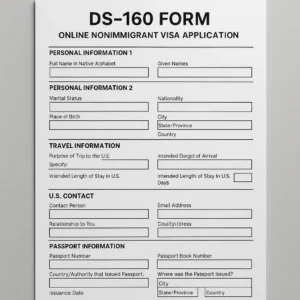
While we are not immigration attorneys and do not provide legal advice, we offer hands-on support to help you better understand the process. From selecting the appropriate visa category for your situation to organizing your application documents, our team is here to assist you every step of the way. We help you complete required forms like the DS-160 or DS-260, ensure that your supporting materials are accurate and properly formatted, and keep you on track with important deadlines and requirements.
If your documents need to be translated, we can handle that too, making sure everything is ready to submit to the appropriate agency or consulate. Our goal is to help make the process smoother, more organized, and less stressful, whether you’re applying as a student, professional, investor, or family member.
Every successful immigration journey begins with clarity and preparation. If you’re visiting the U.S. for a short stay or planning a more permanent move, understanding your visa options is the first step toward achieving your goals.
At YT Multiservices, we’re here to support that journey with personalized, document-based guidance. If you’re unsure where to begin or just need help getting everything in order, reach out to us today. We’ll help you move forward with confidence, one step at a time.