If you have a pending Green Card application and you are thinking about traveling outside the United States, stop before you book that flight. Leaving the country without the right travel document could mean USCIS considers your application abandoned, and everything you worked so hard for disappears in an instant. That document is called Advance Parole, and you request it through Form I-131.
This guide breaks everything down in plain language: what Advance Parole is, who needs it, how to file, what filing actually costs in 2026 (the rules changed, and most online guides are out of date), the new $1,000 parole fee that has confused thousands of applicants, processing times, and the exceptions that exist. No legal jargon, just clear and accurate information pulled directly from official USCIS sources.
Need help organizing your Form I-131 documents in West Palm Beach? YT Multiservices assists clients every day with document preparation, certified translations, and notarization services. Stop by or call today to get started.
Key Takeaways
- Leaving the U.S. while your I-485 is pending without an approved Advance Parole document can result in USCIS treating your application as abandoned and closing your case.
- Filing Form I-131 for Advance Parole costs $630 in 2026. Since April 1, 2024, you pay this fee whether you file it on its own or at the same time as your I-485. The old “free when filed together” rule no longer applies to new cases.
- A pending I-131 application is NOT a travel authorization. You must wait for the approved physical document before departing the United States.
- USCIS may issue your work and travel permission as one EAD/AP combo card, or as two separate documents. Do not assume you will get a combo card.
- A separate $1,000 immigration parole fee took effect on October 16, 2025. The good news: if you travel on Advance Parole with a pending I-485, you are almost certainly exempt. Do not pay it if you receive a notice. Carry your I-485 receipt instead.
- Renew your EAD and Advance Parole at least 90 days before expiration to avoid any gap in work or travel authorization.
- Holders of valid H-1B, H-4, L-1, or L-2 status may be able to travel without Advance Parole, but this carries real risks and should be verified with a qualified immigration attorney before departure.
What Is Advance Parole? (Form I-131 Explained)
Advance Parole is a travel authorization document issued by U.S. Citizenship and Immigration Services (USCIS). It allows certain noncitizens who are adjusting their immigration status inside the United States to travel abroad temporarily and return without abandoning their pending application.
You apply for Advance Parole by submitting Form I-131, Application for Travel Documents, Parole Documents, and Arrival/Departure Records. Once approved, USCIS issues a document (currently the Form I-512L Advance Parole travel document) that gives you permission to seek re-entry into the United States after a trip abroad. Without it, your departure can be treated as a voluntary withdrawal of your Green Card petition.
One naming note that trips people up: USCIS expanded and renamed this form. If you are reading an older guide that calls it simply “Application for Travel Document,” you may be looking at outdated instructions. Always work from the current edition on uscis.gov.
Advance Parole vs. a Visa: What Is the Difference?
Many applicants confuse Advance Parole with a visa. They are not the same thing.
| Feature | Advance Parole | U.S. Visa |
| Issued by | USCIS (domestic) | U.S. Embassy or Consulate (abroad) |
| Purpose | Re-entry while adjustment is pending | Initial entry or re-entry for visa holders |
| Required form | I-131 | DS-160 |
| Tied to | Pending I-485 application | Specific visa category |
| Replaces a visa? | Only for re-entry while I-485 is pending | No |
A visa allows you to travel to and enter the U.S. Advance Parole is specifically designed to protect your pending adjustment of status application when you need to leave the country temporarily.
Who Needs to Apply for Advance Parole?
You generally need Advance Parole if all three of the following apply to you:
- You have a pending Form I-485 (Application to Register Permanent Residence or Adjust Status).
- You do not hold a valid nonimmigrant status that independently allows re-entry.
- You plan to travel outside the United States before your Green Card is approved.
If you leave without Advance Parole and without a qualifying status, USCIS will typically consider your I-485 abandoned and close your case. This is not a technicality. It is one of the most consequential mistakes an applicant can make, and it can set your immigration journey back by years.
What Happens If Your Advance Parole Expires While You Are Abroad?
Many applicants overlook this scenario entirely. If your Advance Parole document expires while you are still outside the United States, you may not be able to re-enter. You would then need to explore alternatives such as consular processing or other legal remedies, which can take months. The safest approach is to return well before your Advance Parole expires, and to plan trips that comfortably fit inside the document’s validity period. If your timing is tight, talk to a qualified immigration attorney before you depart.
What Filing Actually Costs in 2026
This is where almost every outdated guide gets it wrong, so read carefully.
For years, if you filed Form I-131 together with your Form I-485, the I-131 was free. That changed. Under the USCIS fee rule effective April 1, 2024, the Advance Parole fee is $630, and you pay it separately even when you file concurrently with your I-485. There is no longer a bundled discount for new filers.
There is exactly one situation where Advance Parole is still free: if you filed your I-485 on or after July 30, 2007, and before April 1, 2024, paid the I-485 fee at that time, and your I-485 is still pending. Those older cases keep the old bundling. Everyone filing today pays the $630.
| Situation | I-131 Advance Parole Fee |
| Filed standalone (after I-485 already submitted) | $630 |
| Filed concurrently with an I-485 submitted on or after April 1, 2024 | $630 |
| Filed concurrently with an I-485 submitted before April 1, 2024 (still pending) | $0 |
One small piece of good news: the old separate $85 biometrics fee is gone for this form. It is now folded into the $630, so there is nothing extra to add on top.
You can confirm the current amount any time on the official USCIS Fee Schedule. Fees do change, so verify before you write the check.
Should You Still File Concurrently? Yes, and Here Is the Real Reason
Now that concurrent filing is no longer free, applicants ask whether it is still worth doing. In most cases, yes, but the reasoning has shifted from “it’s free” to “it’s smart insurance.”
Filing I-131 alongside your I-485 keeps both requests under one case file, tends to streamline processing, and means your travel permission is already in motion if life forces an unexpected trip abroad. Family emergencies, work obligations, and personal circumstances rarely announce themselves in advance. By the time many applicants realize they need Advance Parole, they are looking at a standalone filing plus the wait that comes with it.
At $630, this is no longer a no-brainer freebie but weigh it against the alternative: leaving the country without it and having your entire Green Card case declared abandoned. As insurance against that outcome, the fee is modest. If there is any realistic chance you will need to travel during your adjustment process, filing concurrently is still the smarter default.
The New $1,000 Immigration Parole Fee: What You Actually Need to Know
This is the single most confusing development of the past year, and it has caused real panic. Here is the plain truth.
On October 16, 2025, the Department of Homeland Security implemented a new $1,000 immigration parole fee required by federal law (HR-1, the One Big Beautiful Bill Act). It applies to certain people who are paroled into the United States, and it is collected at the port of entry, not when you file Form I-131.
Starting in late 2025, many Advance Parole applicants began receiving official notices about this fee in the mail. Understandably, a lot of people assumed they suddenly owed an extra $1,000. In most adjustment of status cases, they do not.
The DHS notice lists ten exceptions. One of them, Exception #7, covers exactly the typical Advance Parole traveler: a lawful applicant for adjustment of status under INA section 245 who is returning to the United States after temporary travel abroad. In plain terms, if you have a pending I-485 and you travel briefly on an Advance Parole document tied to that I-485, you are exempt.
What you should actually do:
- Do not pay the $1,000 fee if you receive the notice and you are traveling on Advance Parole with a pending I-485.
- Keep the notice, and travel with your I-485 receipt notice and your Advance Parole approval so you can prove the exemption at the port of entry if a CBP officer asks.
- Keep your trip genuinely temporary. DHS has not precisely defined how long a “temporary” trip can be before the exemption is questioned. Shorter, clearly temporary trips are safest. If you plan to be abroad for an extended period, confirm your situation with an immigration attorney first.
This exemption is one of the most reassuring facts in this entire guide, and it is exactly the kind of detail that gets lost in outdated articles. If you are an ordinary Green Card applicant traveling on Advance Parole, the headlines about a new $1,000 fee almost certainly do not apply to you.
The EAD/AP Combo Card (and Why You Might Get Two Cards Instead)
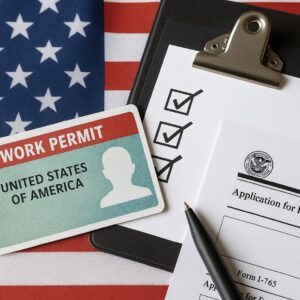
If you also file Form I-765 (Application for Employment Authorization) along with your I-485, USCIS may issue a single combination document known as the EAD/AP combo card, which serves as both your work permit and your travel document.
Here is the nuance most guides miss. Since February 2022, USCIS often decouples these two requests. To speed up work permits, the agency may adjudicate the I-765 first and issue a standalone Employment Authorization Document, then process the I-131 separately and issue the Advance Parole travel document on its own. The result is that many applicants now receive two separate cards rather than one combo card.
Practically, this means:
- Do not assume you will get a combo card. You might, or you might receive a separate EAD and a separate Advance Parole document.
- Either way, the Advance Parole document (or the combo card) is what authorizes your international re-entry. Carry it whenever you travel.
When Does the Card Expire?
The EAD/AP combo card, and the standalone documents, are typically valid for two years from issuance, though validity periods vary. Apply for renewal at least 90 days before expiration to avoid any gap.
A lapse in your EAD means you temporarily lose work authorization, which can affect your employment. A lapse in your Advance Parole means you cannot travel internationally without risking abandonment of your I-485. Both are avoidable with timely renewal.
What to Do If Your Card Is Lost or Stolen
If your combo card or Advance Parole document is lost or stolen, you will generally need to file a new I-765 and a new I-131 to replace it. Report the loss promptly, and do not travel internationally without a valid Advance Parole document in hand. Contact USCIS and, if needed, speak with a qualified immigration professional about your specific situation.
Getting ready to file your I-131 or a renewal? Our team at YT Multiservices in West Palm Beach helps you gather, organize, and prepare your supporting documents so your application is complete and ready to submit. Schedule your appointment today.
Exceptions: Who Can Travel Without Advance Parole?
Not everyone with a pending I-485 needs Advance Parole. Certain nonimmigrant categories allow their holders to travel abroad and return while their Green Card case is pending, without an I-131 approval.
H-1B and H-4 Status Holders
Individuals holding valid H-1B status (specialty occupation workers) or H-4 status (their dependents) may travel abroad and return on their status, provided it remains valid and they continue to meet its requirements. Because the H-1B is employer-sponsored, employer cooperation matters, and a change in employment during the trip could affect re-entry. Confirm your specific situation with a qualified immigration attorney before traveling.
L-1 and L-2 Status Holders
L-1 (intracompany transferees) and L-2 (their dependents) holders with valid status may likewise travel without Advance Parole. The status must remain valid and the holder must maintain qualifying employment throughout the trip. Organizational changes at the sponsoring employer during the trip can complicate re-entry.
K-1 and K-3 Visa Holders
K-1 (fiancés of U.S. citizens) and K-3 (spouses of U.S. citizens) holders fall into a different category. They generally cannot use their original visa for re-entry once they have filed for adjustment of status. For these individuals, obtaining Advance Parole before traveling is strongly recommended.
Why the Exceptions Are Not Guarantees
Even if you hold one of these categories, traveling while your I-485 is pending carries real risk. Immigration officers at ports of entry have discretion over admissibility, and a status that looks valid on its face can still create complications if circumstances changed. Always confirm your specific situation with a qualified immigration professional before making international travel plans.
A Risk Worth Understanding Before You Leave: Unlawful Presence
Here is an insight that rarely makes it into beginner guides but matters enormously for some applicants. If you entered the United States without inspection (EWI) or accrued a period of unlawful presence before filing your I-485, leaving the country, even on Advance Parole, can raise complex re-entry issues. In some situations, prior unlawful presence can trigger bars to re-entry, and Advance Parole does not automatically cure every one of them.
The law in this area is nuanced and fact-specific. Some adjustment applicants who travel on Advance Parole are protected from triggering certain unlawful presence bars, and others are not, depending on their exact history. This is not a do-it-yourself determination. If you have any history of entering without inspection, overstaying a prior status, or accruing unlawful presence, speak with a qualified immigration attorney before you travel. The cost of that consultation is trivial compared to the cost of being barred from returning.
How to Apply for Advance Parole in 2026: Step-by-Step
Step 1: Complete the Current Edition of Form I-131
Download the latest version of Form I-131 directly from uscis.gov. USCIS substantially revised and restructured this form, so a saved copy from a prior application is very likely outdated. Using an obsolete edition is one of the most common reasons applications get rejected.
When completing the form, select the application type for an Advance Parole Document based on your pending I-485, then follow the current instructions for which parts to complete and which to skip. Because USCIS reorganized the part and item numbering in the latest edition, do not rely on item numbers quoted in older articles. The official instructions packet that accompanies the current form tells you exactly which boxes to check.
Step 2: Gather Supporting Documents
Your I-131 package for Advance Parole should generally include:
- A copy of your Form I-485 receipt notice (Form I-797)
- A copy of your passport (photo page and any pages with U.S. entry stamps) or another official photo identity document
- Two passport-style photographs (2 x 2 inches, taken within the last 30 days)
- Evidence or a written statement explaining the educational, employment, or humanitarian reason for travel
- Copies of any prior Advance Parole approvals, if applicable
- The $630 filing fee (unless you qualify for the pre-April 2024 exception described above)
Document requirements vary by case. Always check the official instructions for Form I-131 for the current checklist before you assemble your package.
Step 3: File Online at myUSCIS or Mail to the USCIS Lockbox
USCIS accepts online filing for many I-131 categories through your myUSCIS account. Online filing generally lets you track your case in real time. Note that certain categories must still be filed on paper, so follow the current instructions for your specific request. If you mail your application, send it to the correct direct filing address for your situation, which is listed on the USCIS website. Sending it to the wrong address causes delays.
Step 4: Attend a Biometrics Appointment (If Required)
Depending on your case, USCIS may schedule a biometrics appointment after receiving your I-131. You will get a notice in the mail with the date, time, and location at a USCIS Application Support Center. Missing it without rescheduling in advance can delay or jeopardize your application.
Step 5: Wait for Approval Before You Travel
This cannot be emphasized enough: do not leave the United States until your Advance Parole document is approved and physically in your hands. A pending application is not travel authorization. Only the approved document, or the combo card, gives you the right to seek re-entry. If you are uncertain about your status, wait and verify before you depart.
Advance Parole Processing Times in 2026
Processing times fluctuate based on USCIS workload, the service center handling your case, and your individual circumstances. The figures below are general planning estimates only.
| Filing Type | Approximate Processing Time |
| Concurrent with I-485 | Several months, often in the range of 5 to 9 months |
| Standalone I-131 (after I-485 filed) | Often in the range of 3 to 6 months |
| Online vs. paper filing | Online can be modestly faster |
| Expedite request (qualifying reason) | Case-by-case, no guaranteed timeline |
Because these timeframes shift throughout the year, always check your specific category against the official USCIS Processing Times page before relying on any estimate.
How to Request Expedited Processing
If your trip is urgent, USCIS allows expedite requests in limited circumstances. Qualifying reasons generally include severe financial loss to you or your employer, urgent humanitarian situations, U.S. government interests, and other compelling circumstances at USCIS discretion. Supporting documentation is required, and approval is never guaranteed. Submit the request as early as possible with as much evidence as you can.
Common Mistakes That Get Advance Parole Applications Denied or Delayed
| Mistake | Why It Causes Problems |
| Using an outdated edition of Form I-131 | USCIS rejects applications filed on obsolete form editions |
| Leaving the country before approval | USCIS may treat the I-485 as abandoned |
| Assuming concurrent filing is still free | Missing the $630 fee gets the package rejected |
| Paying the $1,000 parole fee when exempt | Adjustment applicants on Advance Parole generally do not owe it |
| Missing passport-style photos | Application returned as incomplete |
| Forgetting the I-797 receipt notice copy | USCIS cannot verify your pending case without it |
| Not explaining the reason for travel | Weakens the application and can trigger a Request for Evidence |
| Selecting the wrong application type on the form | Causes processing delays or rejection |
| Ignoring renewal deadlines | A gap affects both work and travel rights |
| Traveling before the physical document arrives | A pending application is not travel authorization |
Reviewing your package carefully before submission prevents most of these issues. If you are unsure whether your documents are complete, having a professional review it before you file is always a smart step.
Frequently Asked Questions About Form I-131 and Advance Parole
Can I travel while my Advance Parole application is still pending? No. A pending application does not authorize international travel. Wait until USCIS approves it and you physically receive the document before departing.
Do I owe the new $1,000 parole fee if I travel on Advance Parole? In most adjustment of status cases, no. If you have a pending I-485 and travel temporarily on an Advance Parole document tied to it, you fall under an exception. Do not pay the fee, and carry your I-485 receipt and Advance Parole approval to prove the exemption at the port of entry.
Is filing I-131 with my I-485 still free? Only for older cases. If your I-485 was filed before April 1, 2024 and is still pending, your Advance Parole may still be free. For any I-485 filed on or after April 1, 2024, the I-131 costs $630 even when filed together.
Does Advance Parole guarantee re-entry into the United States? No. It grants permission to seek re-entry. Customs and Border Protection officers retain authority to determine admissibility. Most holders re-enter without issues, but carry your full document package when you return.
What documents should I carry when re-entering with Advance Parole? Your Advance Parole document or combo card, your valid passport, your I-485 receipt notice (Form I-797), and any other documents relevant to your adjustment case.
How many times can I travel on the same Advance Parole document? In most cases the document allows multiple trips within its validity period, but it will specify single or multiple entry. Read your approval notice carefully.
Can I apply for Advance Parole if I entered without inspection (EWI)? You can apply, but this is a complex situation. Prior unlawful presence or an EWI entry can create re-entry barriers that Advance Parole does not always overcome. Have a qualified immigration attorney evaluate your specific facts before you travel.
How YT Multiservices Helps You Prepare Your Documents in West Palm Beach
We are not a law firm and do not provide legal advice. What we do is help individuals and families in the West Palm Beach area prepare the supporting documents they need for their immigration filings.
Our document services include:
- Certified translations of foreign-language documents (birth certificates, marriage certificates, diplomas, and more)
- Notarization services for documents that require notarial acknowledgment
- Document organization assistance to help you assemble a complete, well-ordered application package
- Apostille processing support for documents that will be used in Hague Convention countries
When it comes to Form I-131, we help you gather, translate, and organize the supporting documents that accompany your application, so that when you or your attorney submit the filing, everything is in order and nothing is missing.
Visit us in West Palm Beach. Our team is here Monday through Saturday. Call us today and let us help you take the next step with confidence.