If you are searching for the U visa, it is usually because you are trying to rebuild safety and stability after something difficult happened, not because you are casually comparing immigration categories. U nonimmigrant status is a humanitarian protection for certain victims of qualifying crimes who suffered substantial harm and who were helpful, are helpful, or are likely to be helpful to law enforcement in the investigation or prosecution of that criminal activity.
It also makes sense if you feel confused by timelines, because U cases move through multiple stages and the program has a yearly limit on the number of principal approvals, which creates a long pipeline even for well-prepared filings. The best way to protect your peace of mind is to focus on what USCIS officially says the program is, what each milestone means, and what you can realistically track while you wait.
One important note before we dive in: this article is general information, not legal advice. YT Multiservices is a Florida Notary Public and immigration forms preparation service, so the support is administrative, such as helping you prepare forms based on the information you provide and organizing your documents in a clear, consistent way, not offering legal strategy or representation.
What Is A U Visa?
USCIS explains that U nonimmigrant status is for victims of certain crimes who have suffered mental or physical abuse and who are helpful to law enforcement or government officials in the investigation or prosecution of that criminal activity. The idea behind the program is public safety, because it encourages victims to cooperate with authorities without fear being the only thing shaping their choices.
A U case is evidence-driven, which means USCIS is looking for clear documentation that connects your experience to the program’s requirements. In practice, that means the petition needs to show the qualifying crime, the harm, and the “helpfulness” element in a way that is organized and easy to understand, because USCIS has to make decisions based on what is in the record.
One of the central pieces in most U filings is the law enforcement certification, commonly referred to as Form I-918, Supplement B. USCIS’s law enforcement resource guide explains the certification’s role in establishing key eligibility elements tied to the crime and cooperation, which is why people often treat it as a cornerstone document.
A major structural reason U timeline can be long is the statutory cap for principal U-1 visas each fiscal year. USCIS confirms that Congress limited approvals of principal petitioners to 10,000 per fiscal year, and when demand exceeds that limit, many eligible petitioners cannot be granted final U-1 status right away.
If you are outside the United States or trying to understand how a consular step would work, it helps to know the U process begins as a petition to USCIS rather than a traditional “apply at a consulate first” pathway. The U.S. Department of State explains the U category as a petition-based classification where USCIS is the first decision-maker.
U Visa Process
The main petition for U nonimmigrant status is Form I-918, and USCIS’s I-918 page is the best starting point to confirm current instructions, alerts, and any filing-specific updates. Even if you have been researching U for months, it is smart to treat the official I-918 page as your final checkpoint before you assemble and submit anything.
One reason the U process feels different from many other filings is that it can include meaningful intermediate milestones before final U-1 approval is even possible under the cap. USCIS describes the Bona Fide Determination process as an initial review for certain pending U petitions that includes checking initial evidence requirements and completing background checks, and it can lead to discretionary decisions like deferred action and employment authorization in appropriate cases.
When the annual cap has been reached, USCIS uses a waiting list mechanism, and USCIS policy explains that principal petitioners placed on the waiting list generally receive a grant of deferred action (or, in limited circumstances, parole) and are eligible for employment authorization. This matters because “waiting list” is not a denial, and it is also not the same as final U-1 approval, even though it can bring meaningful protections for some people.
A surprisingly common source of avoidable delay is mailing a petition to the wrong place after USCIS updates filing locations. USCIS maintains a dedicated page for lockbox and service center filing location updates, and checking it right before you mail is one of the simplest ways to prevent an administrative setback that costs time.
If you want to make the process feel less chaotic, one of the biggest administrative advantages is a clean, consistent submission: readable copies, organized supporting documents, and answers that match the evidence you include. If you would like help on that non-legal side of the process, YT Multiservices can help you prepare forms based on your information and organize your documentation so your packet is clear and professionally assembled.
Visa U Processing Time
“Processing time” for U cases is tricky because it can mean different things depending on what stage you are talking about, and it can change as USCIS workloads shift. USCIS directs the public to its official processing times tool for the most current, form-specific snapshot, which is much safer than relying on old timeline estimates online.
It also helps to understand what USCIS means by the processing time it publishes, because it is not a promise for any individual case. USCIS explains the processing time metric and provides guidance on how to interpret time ranges and when someone can submit an inquiry if a case is outside normal time.
For U petitions, people sometimes encounter older timeline discussions that do not match current reality because historic metrics and the stage being measured have changed over time. USCIS itself provides historic context for processing time methodologies, which is useful when you are comparing what you see online with what USCIS is actually measuring today.
Because of the annual cap, the healthiest way to plan is usually to think in stages rather than pinning your life to a single final approval date. That stage-based mindset keeps you grounded in what can happen while a petition is pending, and it helps you focus on practical steps like tracking notices and keeping your documents ready.
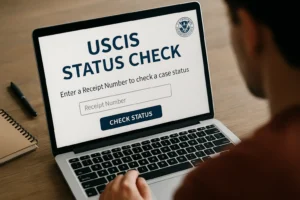
If you want a reliable way to check whether USCIS has taken an action on your case, the USCIS case status tool is the standard place to track updates using your receipt number. It will not shorten the wait, but it can reduce guesswork by showing when USCIS posts a status change.
U Visa Processing Time After Biometrics
A biometrics appointment is an important milestone, but it is not the same thing as a signal that approval is right around the corner. USCIS policy makes clear that background and security checks are part of adjudication steps, and those checks are relevant to processes like the bona fide determination review and other discretionary decisions.
After biometrics, many people experience a long stretch of silence, and it can feel discouraging because it is hard to know what is happening behind the scenes. USCIS does not publish a simple rule that says “after biometrics, you will hear back in a fixed number of days” for U petitions, so the safest approach is to rely on official notices and case tools rather than unofficial predictions.
If you want a practical next step after biometrics that actually helps, it is usually administrative: keep your receipt and notices together, make sure your address is current, and track your case using official tools so you do not miss an update. USA.gov’s guidance on checking case status points people to the USCIS case status tool and explains that you will need your receipt number.
If paperwork stress is piling up while you wait, you do not have to carry it alone, especially when life is already heavy. YT Multiservices can help you keep your file organized and your forms consistent so that if USCIS sends a notice or asks for something later, you are not scrambling to rebuild your documentation from memory.
U Visa Approval Time
In everyday language, “approval time” usually means the moment USCIS grants U-1 status, but in practice many people see meaningful intermediate steps before a final approval is possible under the annual cap. USCIS policy explains that through the bona fide determination process, USCIS may exercise discretion to grant deferred action and employment authorization to certain petitioners whose cases meet the process requirements.
USCIS also explains the waiting list as a formal mechanism used when the cap has been reached, and it clarifies that principal petitioners placed on the waiting list generally receive deferred action and are eligible for employment authorization. This is why you may hear people talk about receiving certain protections while still “waiting on the U,” depending on what stage USCIS reaches in their petition.
Because U cases are shaped by a cap and by shifting workloads, it is important to avoid anyone promising a guaranteed approval date. The most responsible way to plan is to use USCIS’s live tools and official guidance for context, and to treat your timeline as variable, even if you know someone whose case moved faster or slower than yours.
If your priority is to reduce preventable delays, the best move is to submit a clean, consistent packet and keep your administrative life organized while you wait, including saving every notice and keeping your address current. When you want help with the document-prep side, YT Multiservices can support you by organizing your materials so your file is easier to manage across a long timeline.
U Visa Waiting List
The waiting list exists because demand has exceeded the annual limit for a long time, and USCIS confirms the statutory cap for principal U-1 approvals each fiscal year. When that cap is reached, USCIS may place eligible petitioners on the waiting list instead of granting final U-1 status immediately, even when the petition is otherwise approvable.
Being placed on the waiting list is not a denial, and it is not a sign the case is “going nowhere.” USCIS policy describes the waiting list as a step for eligible petitioners who cannot yet be granted U status due to the cap, and it explains the protections that generally accompany waiting list placement, such as deferred action and eligibility for employment authorization.
It also helps to use careful language, because “waiting list,” “bona fide determination,” “deferred action,” and “work authorization” are related but not identical concepts. USCIS has published FAQs on the U visa and the bona fide determination process that point readers to the official policy manual chapters and help clarify what USCIS is doing and why.
If your goal is to get through the waiting phase with less anxiety, your personal paperwork system matters more than most people realize. Having one organized folder with your full copy, receipts, notices, and supporting documents can make a huge difference if you need to respond quickly to a request or show proof of a pending filing for practical life reasons.
How Long Does It Take To Get A Green Card After A U Visa?
Many people pursue U status with a long-term goal of permanent residence, and USCIS provides an official page specifically about a green card for a victim of a crime (U nonimmigrant). USCIS explains that this is a separate step for eligible people who already have U nonimmigrant status and meet the adjustment requirements, which is why “U approved” does not automatically mean “green card next.”
A practical way to think about it is that the green card step is a new application with its own evidence and its own timeline, and USCIS will review it separately from the original U petition. The U.S. Department of State’s overview also reinforces that eligible U nonimmigrants file Form I-485 with USCIS to adjust status, which helps set expectations that permanent residence is a later chapter, not an immediate follow-up.
Because policies and definitions can matter at the adjustment stage, it is especially important to rely on current USCIS guidance when you get there. For example, USCIS issued a policy alert in late 2025 clarifying that a grant of U nonimmigrant status to someone in the United States is not an “admission” for certain adjustment purposes under INA 245(a), which shows how technical updates can shape how applications are processed.
When you eventually reach the green card stage, your strongest advantage is still administrative clarity: consistent identity documents, properly translated records when needed, and a tidy history of your USCIS notices and filings. If you want support with preparing and organizing paperwork and certified translations for official use, YT Multiservices can help you keep your documents clear and ready for future filings.
Latest U Visa News
If you want “latest U visa news” you can actually act on, start with USCIS alerts, because USCIS posts updates that directly affect petitioners. On the official I-918 page, USCIS posted an alert dated December 1, 2025 stating that as of September 9, 2025 USCIS met the fiscal year 2025 statutory cap of 10,000 principals who can be issued U-1 nonimmigrant visas, which is a concrete update that helps explain why final approvals are limited each year.
Another late-2025 update that can affect real timelines is where you mail your package, because filing locations can change. USCIS’s filing location updates page states there was a 30-day grace period for Form I-918 and that USCIS would accept forms sent to Service Center Operations – Nebraska that were postmarked before December 1, 2025, which is exactly the kind of operational detail that can prevent an avoidable rejection.
It is also smart to watch form edition requirements, because USCIS sometimes updates forms and sets rules about which editions will be accepted after a certain date. USCIS maintains a forms updates page where you can verify current edition acceptance guidance, and the safest habit is to download the form fresh from USCIS right before you prepare and sign.
If you want to keep up with official changes without relying on rumors, USCIS’s newsroom alerts section is a reliable place to monitor timely updates and policy announcements. Even when an alert is not U-specific, it can affect operational issues like forms, filing procedures, or agency-wide processing changes that touch many petition types.
If you want the calmest next step, choose actions you can control today: build a clean document folder, keep your notices safe, and use official USCIS tools for tracking rather than timeline chatter. When you are ready for hands-on administrative support, YT Multiservices can help you prepare forms and organize your documentation so your filing is clear, consistent, and easier to manage through a long wait.